
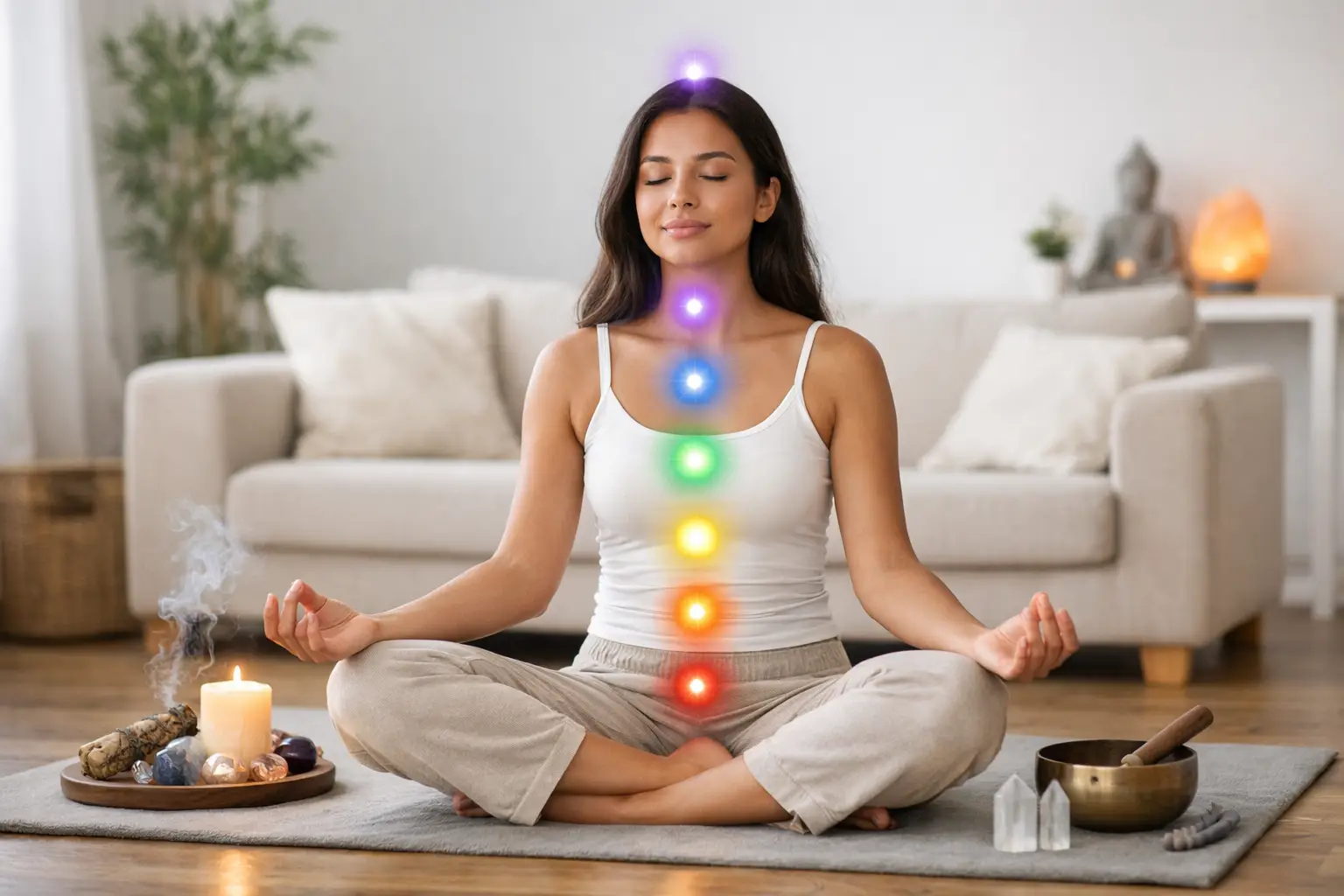
Some days the signs are subtle. You may wake feeling tired after a full night’s sleep, become emotionally affected by small things or move through the day with the sense that something within you is no longer in harmony. If you are wondering how to balance chakras at home, begin by understanding chakra work for what it is within yogic and energetic traditions: a way of becoming more conscious of the relationship between body, energy, emotion, mind and spiritual awareness.
Chakra balancing is not about becoming someone else or trying to create extraordinary experiences. Its deeper purpose is greater harmony. As awareness develops, you may become more grounded in physical life, clearer about your emotions and thoughts, and more conscious of what strengthens or disturbs your inner balance. This is why home practice matters. Energetic work is not confined to a healing session; it is also supported by the way you live each day.
What chakra balancing really means
The chakras are understood within yogic and energetic traditions as subtle centres associated with different aspects of human experience and Consciousness. Imbalance may be described as weakness, excess, contraction or lack of harmony between one centre and the wider energetic system.
This is where chakra work is sometimes misunderstood. Balancing does not mean trying to activate every chakra as strongly as possible. One area may need greater grounding, another greater openness, while another may simply need to come back into a better relationship with the rest of the system.
A balanced energetic system is not necessarily dramatic. The deeper signs may be much more ordinary: greater steadiness, less automatic reaction, clearer awareness and a stronger ability to remain present in daily life.
How to balance chakras at home without overcomplicating it
The most useful home practice is simple enough to continue. You do not need elaborate equipment or a room filled with spiritual objects. Quietness, sincerity, regularity and attention are more important.
Choose a time when you can practise without unnecessary interruption. Early morning is traditionally valued because the surroundings and mind are often quieter, while evening can provide a useful transition away from the activity of the day. What matters most is that your practice develops a rhythm.
Sit comfortably with the spine upright but not rigid and allow the breathing to become natural. Before beginning, establish a simple intention. You may inwardly recognise that you are sitting to become more conscious, grounded and harmonious rather than trying to force energy to move.
Begin with the foundation rather than immediately concentrating on the higher centres. Spiritual development needs grounding. Focusing heavily on higher practices while ignoring physical life, emotional instability or exhaustion can make practice less balanced rather than more profound.
Begin with the root chakra
Bring awareness towards the base of the body and notice your physical contact with the chair, cushion or ground beneath you. Feel the weight of the body and allow yourself to become consciously present.
You may visualise a steady red light if colour helps your concentration, but visualisation is not essential. The important movement is towards grounding rather than towards producing a particular sensation.
The root chakra is also supported through very practical aspects of life. Regular food, sufficient rest, walking, contact with nature and a more stable daily rhythm can all strengthen the experience of grounding. This is an important reminder that chakra healing should never be separated from the way a person actually lives.
Move upward with awareness, not force
From the root, bring attention gradually towards the second chakra in the lower abdomen. Within the IAMGODIAM understanding, this centre is connected with life force, sexuality, creativity, power and emotional movement. Simply observe what becomes noticeable without deciding in advance what you are supposed to feel.
Continue towards the third chakra. This is an important centre of emotion, reaction and personal power. Rather than imagining that it must become stronger, observe how you use power in your life. Do you continually surrender it? Do you try to control everything? Do emotion and reaction repeatedly determine your choices?
Then bring attention towards the Heart. Within IAMGODIAM, the Heart occupies a particularly important place because it is connected with Love, compassion, softness, care, understanding and mature human relationship. Heart work should never be forced. Greater Love does not mean becoming defenceless or sacrificing yourself continually; Love and truth must develop together.
The throat relates to expression and truth, the third eye to inner seeing and discernment, and the crown to surrender and the relationship with a greater spiritual reality. These higher centres are best approached upon a stable foundation rather than as shortcuts towards spiritual experience.
A simple chakra meditation you can do daily
A home chakra meditation does not need to be complicated. Sit quietly, become aware of the physical body and allow your breathing to settle before moving attention through the centres.
Begin at the root and remain there for several breaths. Then move slowly towards the second chakra, third chakra, Heart, throat, third eye and crown. At each centre, observe rather than diagnose.
You may notice sensation, emotion, imagery or very little at all. None of these responses automatically tells you whether a chakra is balanced or blocked. The purpose is to develop relationship and awareness over time.
If visualisation helps, you can imagine each centre becoming clearer and more harmonious as you breathe quietly. If mantra is part of your established spiritual practice, this may also be used. There is no need to force either method simply because it is commonly associated with chakra meditation.
When you reach the crown, remain still for a short time. Then bring awareness gradually down through the centres again until you return to the physical body and the root. This downward movement is important because deeper spiritual practice should return you to embodied life rather than leave you feeling removed from it.
Support chakra healing with sound, breath and lifestyle
If you are serious about how to balance chakras at home, remember that meditation is only one aspect of the process. Food, sleep, daily rhythm, emotional habits, relationships and the way attention is used can all influence how balanced or scattered you feel.
Conscious breathing can support meditation by gathering attention and reducing unnecessary agitation. Gentle breathing is usually sufficient for home practice. More demanding pranayama techniques are better learned properly rather than copied casually, particularly when someone is already highly anxious or physically unwell.
Sound may also be used through mantra, devotional chanting or simple vocal vibration. Different traditions use sound in different ways, and its purpose should remain spiritual concentration rather than the expectation that a particular tone will automatically “open” a chakra.
Lifestyle is equally important. Continual overstimulation, irregular sleep, emotional suppression and constant digital input can make inner quietness more difficult. If meditation feels peaceful for ten minutes while the rest of life remains completely disordered, the deeper imbalance may simply continue.
This is where Ayurveda can add an important foundation. Constitution and present imbalance influence what kind of food, rhythm, activity and rest are appropriate. Someone who is depleted may need greater nourishment and grounding, while someone experiencing excessive heat or intensity may require moderation and cooling. A whole-person approach respects these differences.
Signs your chakras are beginning to rebalance
It is better not to measure chakra balance through mystical sensations. Greater harmony often becomes visible first through ordinary life.
You may become more aware of your reactions before acting upon them, communicate more honestly or recognise more clearly when you have lost your grounding. You may also develop greater sensitivity to what supports you and what repeatedly pulls you out of balance.
Emotions can sometimes become more noticeable during energetic work, but they should not automatically be described as energetic release. Meditation may simply make something that was already present easier to recognise.
The same caution applies to fatigue or physical symptoms. Feeling tired after practice does not prove that the system is “recalibrating”. Persistent symptoms can have many causes and should be taken seriously where necessary.
Chakra work can be a meaningful spiritual support, but it is not a substitute for medical or psychological care. Responsible energetic practice keeps both perspectives in their proper place.
When home practice is enough and when guidance helps
Home practice can be valuable for grounding, self-awareness and maintaining a regular relationship with the energetic system. When the practice is simple, stable and understandable, there is no need to make it unnecessarily complicated.
Guidance may become useful when someone feels persistently confused, emotionally overwhelmed or unsure how different energetic patterns relate to one another. One centre may appear to be the problem while the deeper imbalance involves several parts of the system.
This is one reason structured spiritual work can be more useful than collecting random chakra techniques online. A coherent path considers the whole person rather than continually treating one chakra in isolation.
Within IAMGODIAM, chakra work belongs to this wider approach. Meditation, energetic healing, Ayurveda, the aura, the physical body, emotional development and Consciousness are interconnected parts of the total human being.
The real measure of chakra balance is therefore not whether you can identify every centre perfectly or produce particular colours and sensations during meditation. It is whether greater harmony begins to enter the way you live.
Begin simply. Ground yourself. Become quiet enough to observe rather than force. Let awareness develop through consistency, and allow the chakras to become part of a deeper understanding of the whole human being rather than an end in themselves.