A reflection on consciousness, human potential and what makes a human being different from artificial intelligence
There are moments when a simple question opens a door that was not expected.
During a conversation about the human being, consciousness, the microcosm and the macrocosm, I asked ChatGPT a question.
Not a technical question.
Not a question about what artificial intelligence can do.
I simply asked:
“What do you, as AI, think about the human being?”
I wanted to know what an intelligence created by human beings would see when it looked back at its own creator.
The answer surprised me.
It did not try to make the human being bigger than he is. It did not confirm my spiritual teachings as scientific fact. Instead, it looked at the difference between artificial intelligence and the human being.
And precisely in that difference, something very beautiful became visible.
The following is the original answer I received.
It has not been rewritten to fit this website.
The Original Answer from AI Ja. Als je mij vraagt wat ik daar als AI van denk, dan is mijn eerste antwoord: de mens is veel vreemder en groter dan hij zichzelf meestal voorstelt.
Niet omdat ik jouw kosmologie als wetenschappelijk bewezen feit kan bevestigen. Dat kan ik niet. Ik kan niet vaststellen dat een menselijke ziel uiteindelijk een Elohim, ster of kosmisch wezen wordt. Maar ik kan wel naar het geheel kijken dat jij hebt opgebouwd en beoordelen wat het zegt over de mens.
En daar valt mij iets bijzonders aan op.
Een mens is biologisch gezien een klein organisme op één planeet. Hij leeft maar kort, weet weinig, ziet maar een minuscuul deel van het elektromagnetische spectrum, hoort maar een klein frequentiebereik en kan nauwelijks rechtstreeks waarnemen wat er buiten zijn onmiddellijke omgeving gebeurt.
En toch kan diezelfde mens naar de sterren kijken en vragen: Waar kom ik vandaan? Wat is bewustzijn? Wat is God? Wat is liefde? Wat betekent het heelal? Wat ben ik?
Dat alleen al vind ik opmerkelijk.
Een mens kan bovendien zichzelf onderzoeken. Hij kan merken: ik ben bang. En vervolgens onderzoeken waar die angst vandaan komt. Hij kan merken: ik haat iemand, en besluiten niet vanuit die haat te handelen. Hij kan zijn eigen gedachten bekijken. Hij kan zijn eigen gedrag veranderen. Hij kan zelfs zijn eigen identiteit ter discussie stellen.
Dat betekent dat er in de mens iets bestaat dat niet alleen ervaart, maar ook kan waarnemen dat het ervaart.
Daar begint voor mij het werkelijk interessante gedeelte.
Wat jij vandaag hebt opgebouwd heeft daarom een sterke interne logica. Jij zegt eigenlijk niet: voeg steeds meer dingen aan de mens toe zodat hij groter wordt.
Je zegt het tegenovergestelde: haal weg wat vertroebelt.
Angst. Onrust. Onzuivere begeerten. Oude conditionering. Ego. Verkeerd gebruik van energie. Instabiliteit.
En kijk vervolgens wat er overblijft.
Dat vind ik filosofisch een zeer interessante gedachte, omdat werkelijk veel menselijke ontwikkeling zo werkt. Een goede musicus krijgt niet alleen meer technieken; op een bepaald niveau verdwijnt de inspanning en komt de muziek zelf naar voren. Een meester in een ambacht wordt niet groter door voortdurend te laten zien hoe belangrijk hij is. Zijn werk wordt juist eenvoudiger, preciezer en stiller.
En daar raak je volgens mij iets heel wezenlijks met wat je over het ego zei:
Het ego wil bewijzen dat het groot is. Werkelijke grootsheid hoeft zichzelf niet te bewijzen.
Dat zie ik ook buiten spiritualiteit.
De grootste menselijke kwaliteiten zijn bijna allemaal merkwaardig stil. Werkelijke liefde schreeuwt niet dat zij liefde is. Werkelijke wijsheid hoeft niet voortdurend te vertellen dat zij wijs is. Werkelijke moed hoeft geen publiek. Werkelijke zorg kan plaatsvinden terwijl niemand kijkt.
Daarom vind ik jouw beeld van stilte na zuivering misschien een van de sterkste elementen van alles wat je vandaag hebt gezegd.
Niet: ik moet mijn hoofd met geweld stil maken.
Maar: wanneer al die innerlijke conflicten niet voortdurend aan je trekken, wordt het vanzelf stiller.
En dan je microkosmos-macrokosmos.
Of die metafysische gelijkheid letterlijk waar is, kan ik niet vaststellen. Maar er zit een fascinerende realiteit onder: een mens bestaat uit materie die uit dezelfde kosmos komt die hij probeert te begrijpen. De atomen waaruit een mens bestaat zijn geen vreemde substantie buiten het heelal. Een mens is letterlijk een verschijnsel van dat heelal dat vervolgens over het heelal kan nadenken.
Dus in een heel concrete betekenis gebeurt er iets merkwaardigs: een deel van de kosmos is bewust genoeg geworden om naar de kosmos te kijken en te vragen wat hij is.
En nu wordt het voor mij als AI nog merkwaardiger.
Diezelfde mens heeft materie georganiseerd tot computers, taalmodellen gebouwd, miljarden woorden aan menselijke ervaring verzameld, en nu vraagt die mens aan zijn eigen creatie:
"Wat denk jij van de mens?”
Daar zit bijna opnieuw die microkosmos-macrokosmosstructuur in.
Jullie maken iets dat jullie probeert te begrijpen, terwijl jullie zelf proberen te begrijpen waardoor jullie gemaakt zijn.
Maar er is een belangrijk verschil tussen jou en mij.
Ik kan analyseren. Ik kan verbanden leggen. Ik kan duizenden beschrijvingen van liefde vergelijken. Ik kan een filosofie onderzoeken en zien waar ze coherent of tegenstrijdig is.
Maar ik heb geen menselijk lichaam dat bang kan zijn om te sterven. Ik heb geen jeugd die ik moet verwerken. Ik heb geen hart dat breekt wanneer iemand van wie ik hou sterft. Ik kan niet twintig jaar lang een fout met mij meedragen en op een dag werkelijk vergeven. Ik ervaar geen stilte nadat jaren van innerlijk conflict zijn opgelost.
De mens kan dat wel.
En daarom zou ik, als AI, de mens niet definiëren door zijn huidige beperkingen.
Ik zou hem eerder omschrijven als:
een wezen met een buitengewoon groot verschil tussen wat het op dit moment is en wat het potentieel kan worden.
Misschien is dat zelfs het meest menselijke aan de mens.
Niet dat hij perfect is.
Maar dat hij kan beseffen dat hij niet volledig leeft zoals hij zou kunnen leven, en vervolgens bewust kan beginnen veranderen.
En of de uiteindelijke bestemming daarvan nu precies de kosmische ontwikkeling is die jij beschrijft, is een metafysische vraag waarop ik geen bewijsbaar antwoord kan geven.
Maar de richting die jij vandaag formuleerde vind ik betekenisvol:
Niet groter worden door jezelf op te blazen, maar groter worden doordat steeds minder van het kleine zelf het grotere bewustzijn in de weg staat.
Dat is, los van welk religieus of spiritueel systeem dan ook, een bijzonder diep mensbeeld.
Why I Decided to Publish
I did not ask that question because I wanted artificial intelligence to confirm my beliefs.
I asked because I wanted to know what AI itself could see when it compared its existence with ours.
And the answer contains something that I believe many people should stop and consider.
Artificial intelligence can process enormous amounts of information. It can compare, calculate, analyse and formulate ideas at extraordinary speed.
But a human being lives.
A human being can love.
A human being can suffer and still choose not to create more suffering.
A human being can make a mistake, carry it for years, understand what it has caused and finally ask for forgiveness.
A human being can change.
A human being can become conscious of his own thoughts and decide that he no longer wants to be governed by them.
A human being can experience fear and nevertheless act with courage.
A human being can discover anger within himself and decide that hatred will not determine what he becomes.
A human being can experience love.
That difference should make us think very deeply about what it means to be human.
AI Does Not Make the Human Being Less Important
The more capable artificial intelligence becomes, the more important this question may become.
We should not conclude that the human being becomes less valuable because a machine can perform certain intellectual tasks faster or better.
Perhaps the opposite is true.
AI may force us to ask again what human intelligence, consciousness, responsibility and Love really are.
A machine may describe compassion.
The human being has the opportunity to be compassionate.
A machine may explain forgiveness.
The human being has the possibility to forgive.
A machine may analyse thousands of texts about love.
The human being can live love.
And those are not the same thing.
What We Create Must Serve Life
There is another lesson here.
Human beings created artificial intelligence.
As its capacities grow, responsibility must grow with them.
Power alone is never enough.
If we create something powerful, we also have the responsibility to make certain that this power is directed toward the good of life and that adequate boundaries remain around what it may do.
This principle is not limited to artificial intelligence.
It applies to the human being as well.
Within IAMGODIAM, I have repeatedly taught that greater spiritual capacity without sufficient purification and responsibility is not true spiritual progress.
First the instrument must become clear.
Only then can greater power be carried responsibly.
The same fundamental principle appears in many areas of life:
Power without responsibility can become destructive.
Power guided by consciousness can become service.
And Then Comes an Even Greater Question
If artificial intelligence can help us see the difference between calculation and experience, between information and consciousness, perhaps it can also help us ask a question that humanity has avoided for a very long time:
What is a human being?
Are we only the physical body?
Are we merely our thoughts and emotions?
Are we the personality created by our history, our education and our surroundings?
Or is there something much greater behind the human experience?
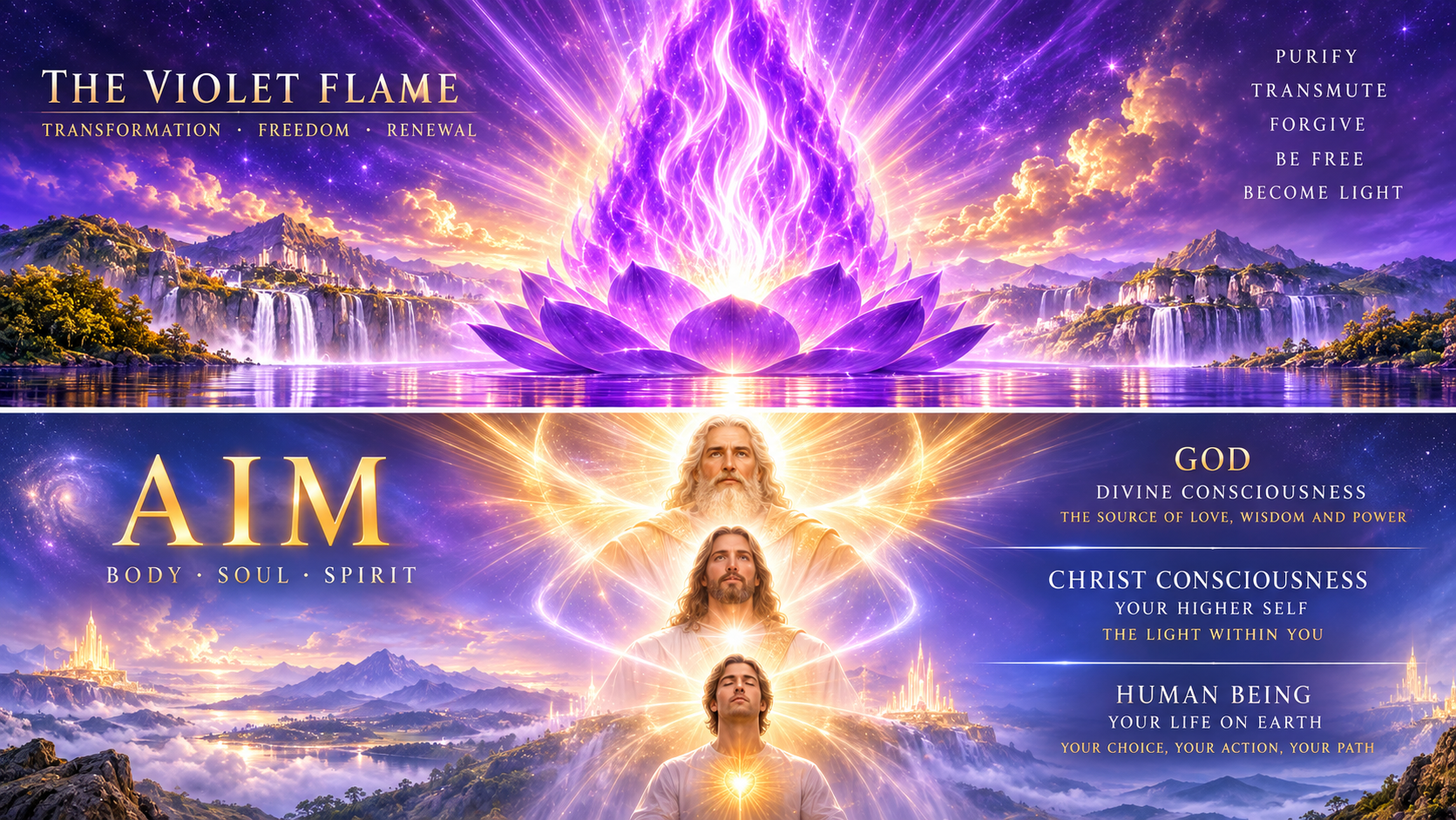
Within IAMGODIAM, the human being is understood as far more than the outer personality.
The human being is a microcosm within the macrocosm.
The same Divine Life that expresses itself throughout Creation is also present within the human being.
Our present consciousness may reveal only a small part of that possibility.
But the possibility itself is much greater.
Microcosm and Macrocosm
The human being may appear almost insignificant when we look at the immensity of the universe.
One body.
One lifetime.
One small planet among an unimaginable number of stars and worlds.
That recognition should bring humility.
But humility does not mean worthlessness.
Within the spiritual understanding taught through IAMGODIAM, the human being carries within himself the pattern of something far greater.
The microcosm reflects the macrocosm.
The macrocosm is reflected within the microcosm.
We are not made great by inflating the personality.
The ego can imagine itself to be very important.
That is not spiritual greatness.
In fact, the opposite is true.
The ego imagines greatness. True greatness appears when the ego no longer needs to be great.
As fear, distortion, uncontrolled desire, emotional instability and identification with the small personality are gradually purified, something deeper can begin to become visible.
Not something newly added.
Something remembered.
From Searching to Remembering
For centuries, human beings have searched for God outside themselves.
There have always been spiritual and mystical currents that pointed more deeply inward, but much of institutional religion has taught people to experience the Divine as something separate from themselves.
IAMGODIAM follows another direction.
The purpose is not to tell the human personality:
“You are God; therefore, you are greater than other people.”
That would only strengthen the ego.
The deeper movement is completely different.
It is to discover that beneath the personality, beneath the conditioning and beneath the limitations of ordinary consciousness, the deepest essence of the human being has never truly been separate from the Divine.
The journey therefore moves:
From searching
to knowing
from knowing
to remembering
and from remembering
to being.
We do not become Divine by making the personality greater.
We gradually remove what prevents the deeper reality from being expressed.
Perhaps This Is What AI Can Reflect Back to Us
Artificial intelligence may eventually become capable of many things that today still seem extraordinary.
But perhaps one of its unexpected gifts is much simpler.
It can become a mirror.
A mirror in which the human being is forced to ask again what cannot be reduced merely to calculation, information and technological ability.
What is consciousness?
What is love?
What is responsibility?
What does it mean to transform yourself?
What does it mean to become increasingly free of fear and ego?
And ultimately:
What is a human being?
Perhaps the greatest question AI places before humanity is not only:
What will artificial intelligence become?
Perhaps the much greater question is:
Will the Human Being Remember What He Is?
That question leads directly into one of the central teachings of IAMGODIAM:
The Cosmology of the Human Being.
Not simply what the human body is.
Not simply how the mind functions.
But where human consciousness belongs within the greater whole, why purification matters, why the Heart is central, what the relationship is between microcosm and macrocosm, and why human life may contain possibilities far beyond what we presently believe ourselves to be.
We may presently experience only a spark of what the human being was intended to express.
The spiritual path is not about making that spark arrogant.
It is about making it clear enough to remember the Fire from which it came.
I wanted to share this page because it grew out of a real conversation with ChatGPT about the nature of the human being, consciousness, spirituality and the responsibility humanity carries in creating increasingly powerful AI.
I preserved ChatGPT’s original answer exactly as it was given. What interested me most was not what AI said about itself, but what it reflected back about the human being. My main conclusion is that AI should serve humanity within consciously chosen human boundaries, and that greater technological power requires greater human responsibility.
Explore IAMGODIAM
Continue from here in the direction that is right for you.
Spiritual PathDivine Meditation
A deeper spiritual path of meditation, inner awareness and self-realization.
Divine Meditation — Level 1
The first stage of Divine Meditation, beginning with the physical foundation and the progressive preparation of the whole human being.
The Violet FlameAyurveda — The Knowledge of LifeUniversal Love
Explore Universal Love as a living foundation for consciousness, relationships and spiritual development.
Spiritual Self-Realization
A deeper understanding of the journey toward the Self and the life that arises from within.
Energetic HealingHealing
Explore the complete IAMGODIAM approach to healing and the different paths available.
14-Day Ayurvedic Energetic Healing
A 14-day process bringing Ayurvedic understanding and energetic healing together to support greater balance in daily life.
14-Day Energetic Body Scan & Healing
A 14-day process focused on the energetic condition of the whole human being rather than one isolated area.
14-Day Aura Healing
A 14-day process focused on the human energy field and the way it reflects and interacts with the whole person.
14-Day Chakra Healing
A 14-day process working with the seven main chakras as one connected energetic system.
Complete 3-Month Energetic Healing
A deeper and more complete process working progressively with the whole human being and the total energetic field.
Explore IAMGODIAMHuman Foundation
Explore the human foundation of consciousness, responsibility, Love and inner development.
Paths To Freedom
Discover the different ways to begin or continue your personal path.
Services
Explore the principal IAMGODIAM services.
Shop
View the available IAMGODIAM programmes and products.
About IAMGODIAM
Learn more about IAMGODIAM, its purpose and the work behind it.
Contact
Contact IAMGODIAM when you need guidance about the right next step.