
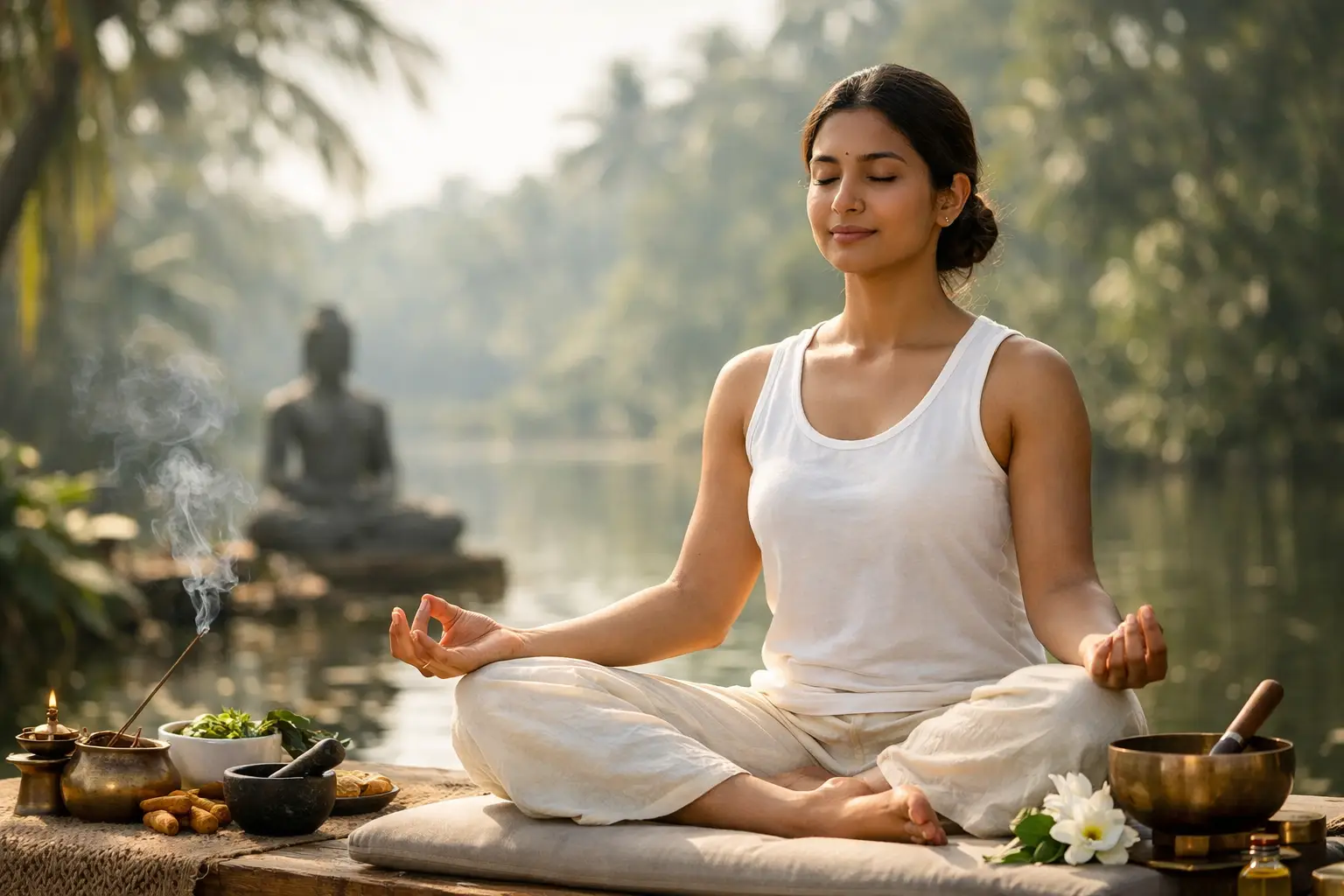
If your mind feels busy even when your body is tired, it may be a sign that the rhythm of daily life needs greater attention. Learning how to start Ayurvedic meditation is not about forcing silence or copying someone else’s routine. It is about understanding your present condition, creating greater balance and developing a practice that supports body, mind, energy and spiritual awareness together.
Ayurveda does not need to treat meditation as an isolated stress-management technique. Within the wider Ayurvedic understanding, thoughts, emotions, digestion, sleep, energy and daily rhythm all belong to the same human being. When meditation is adapted to constitution and present imbalance, it can become part of restoring greater steadiness rather than simply producing a short period of relaxation.
What makes Ayurvedic meditation different
Ayurvedic meditation begins with an important principle: not every person becomes quiet in exactly the same way. Someone with elevated Vata qualities may feel restless, anxious or overstimulated. A person with stronger Pitta disturbance may become intense, driven or mentally sharp, while Kapha imbalance may be experienced as heaviness, dullness or difficulty becoming inwardly alert.
The same practice may therefore not be equally suitable for everyone. Someone who feels scattered may first need grounding and regularity. Someone carrying excessive intensity may benefit from softening and moderation, while someone experiencing heaviness may need movement or greater alertness before sitting quietly.
This is one of the strengths of the Ayurvedic approach. The practice begins with the person who is actually present rather than with an idealised image of how meditation should look.
How to start Ayurvedic meditation with the right foundation
Before technique comes preparation, and one of the foundations of Ayurvedic living is rhythm. When waking, eating, activity, rest and sleep become more regular, meditation also receives a more stable place within daily life.
Early morning is traditionally valued because the surroundings are quieter and the mind has not yet become filled with the impressions of the day. Evening may also be appropriate if it provides a conscious transition away from outward activity, although sitting immediately after a heavy meal or intense stimulation can make inward quietness more difficult.
Choose a clean and reasonably quiet place where you can sit without unnecessary interruption. You do not need a special meditation room. A cushion, a supportive chair and a place that can be used regularly are sufficient.
Begin with a duration that you can carry consistently rather than forcing a long practice from the first day. A short, steady period repeated regularly is generally more useful than occasional intensity. Discipline should be clear, but it does not need to become harsh.
Know your present imbalance before choosing a method
If you want to understand how to start Ayurvedic meditation in a way that supports you individually, observe your present condition rather than trying to diagnose your entire constitution from a short description.
If you feel restless, worried, dry, ungrounded or mentally scattered, Vata qualities may be elevated. In that situation, grounding and stability are important. A simple mantra, awareness of the body, quiet breathing or attention towards the Heart may provide a clearer point of return than a completely open-ended practice.
If you feel irritated, overheated, perfectionistic, intensely driven or unable to stop analysing, Pitta qualities may be stronger. The practice can then emphasise softening, surrender and less effort rather than turning meditation into another task to master.
If you feel sluggish, heavy, sleepy or resistant, Kapha qualities may be more prominent. A little movement before sitting, a more upright posture, appropriate breathing or devotional chanting may help create greater alertness before entering stillness.
These are general Ayurvedic principles, not a substitute for individual assessment. The purpose is simply to begin noticing that different inner conditions may require different forms of support.
A simple Ayurvedic meditation routine for beginners
Sit comfortably with the spine upright but not rigid and allow the body to become quiet. Close the eyes gently and first become aware of natural breathing without immediately trying to control it.
Bring attention to the body and notice what is actually present. There may be tension, restlessness, warmth, heaviness or very little sensation at all. Observe without trying to turn every experience into a diagnosis.
You may then allow the breathing to become a little quieter and more regular. There is no need to force a particular ratio unless you have been taught a specific breathing practice. The purpose at this stage is simply to gather attention and prepare for meditation.
Choose one clear point of focus. This may be the breath, a sacred mantra received within an appropriate practice or awareness of the Heart. Remaining with one method for sufficient time is usually more valuable than continually changing techniques because something else appears more interesting.
If you use mantra, repeat it with attention and respect rather than mechanical force. If you use the breath, allow it eventually to become natural. If you work with the Heart, rest awareness there quietly rather than trying to manufacture emotion.
Thoughts will arise. Do not fight them and do not judge the meditation because the mind has moved. Recognise that attention has wandered and gently return to the chosen focus.
At the end, remain quiet for a moment before opening the eyes and returning to ordinary activity. This transition allows meditation to end gradually rather than immediately throwing attention back into stimulation.
What supports the practice outside meditation
Ayurvedic meditation becomes easier when the rest of daily life is not continually working against it. Irregular sleep, skipped meals, excessive stimulation and constant digital input can make the mind and body more difficult to settle.
A few simple changes may therefore support the practice. Eat at reasonably regular times, choose nourishing food appropriate to your constitution and present condition, reduce unnecessary stimulation before meditation and create greater rhythm in sleeping and waking.
If Vata qualities are prominent, warmth, regularity and grounding may be helpful. When Pitta is elevated, moderation, cooling and less internal pressure may be important. When Kapha dominates, greater movement, lightness and stimulation may help prevent dullness.
This is where Ayurveda becomes practical. Meditation is not separated from the way you eat, sleep, move, breathe and use your attention. Daily living either supports inner practice or makes it more difficult.
Common mistakes when starting
One common mistake is expecting immediate transcendence. Meditation may sometimes feel peaceful from the beginning, but deeper development normally requires continuity and patience.
Another mistake is assuming that the most advanced or intense practice must also be the best one. A practice that exceeds a person’s present readiness may create unnecessary confusion or strain. More intensity does not automatically mean more spiritual progress.
People also sometimes interpret any emotion arising during meditation as a sign that something is being released. Greater stillness may simply make an emotion that was already present easier to notice. It is better to observe honestly than to give every experience a dramatic spiritual explanation.
If a meditation practice repeatedly leaves you significantly more anxious, dissociated, distressed or depleted, the answer is not necessarily to force yourself through it. The method may need to be adapted, and professional support may be appropriate where symptoms are significant.
When guided support helps
There is value in learning from someone who understands both meditation and the wider condition of the human being. Experienced guidance can help distinguish when grounding is needed, when greater discipline is appropriate and when a person should not yet move towards deeper practices.
For those who want more than basic relaxation, a structured path can also help meditation develop coherently alongside chakra work, energetic healing, Ayurvedic understanding and spiritual discipline. These approaches should not simply be collected as separate techniques, but understood as different ways of working with the same human being.
This may be particularly useful for people who have tried generic meditation apps yet still feel that their practice lacks direction or depth. Guidance should ultimately lead towards greater independence, discernment and inner responsibility rather than dependency.
Within IAMGODIAM, meditation is approached within this wider movement of human and spiritual development. The purpose is not a quick result, but the gradual development of grounding, Consciousness and a deeper relationship with the Self.
The deeper purpose of beginning
When you begin Ayurvedic meditation, the purpose is not simply to relax. You are learning to create greater order in the relationship between daily rhythm, body, mind, energy and inner awareness.
Some days meditation may feel peaceful, while other days it may feel ordinary or restless. Both can teach you something when the practice is approached honestly and without forcing a particular result.
Begin simply, establish a regular rhythm and choose a method appropriate to your present state. Allow the practice to develop gradually rather than continually searching for a faster or more powerful technique.
The mind does not need to be conquered. It needs to become increasingly conscious, disciplined and capable of turning away from continual outer movement towards the deeper stillness within.
That is where meditation gradually becomes more than something you do for a few minutes each day. It becomes part of learning how to live.