
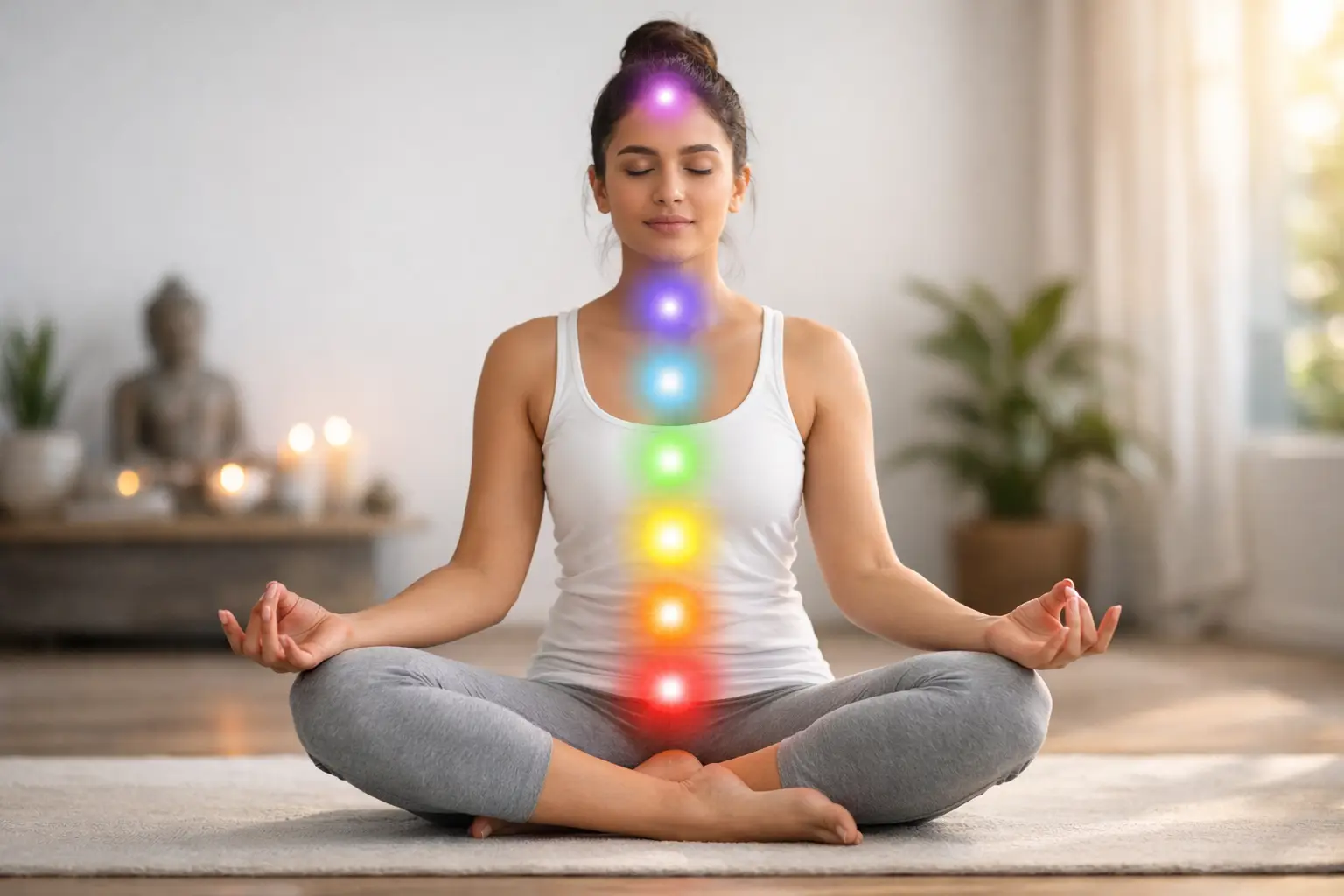
Some people begin chakra meditation because they feel anxious, heavy or emotionally scattered. Others begin because ordinary meditation feels too vague and they want a practice that helps them understand what is happening within. This beginner guide to chakra meditation is intended for both. It offers a simple introduction to an ancient energetic system through which awareness can gradually become more grounded, ordered and inwardly directed.
Chakra meditation is not about forcing mystical experiences. Within yogic and energetic traditions, it is a way of bringing awareness to the subtle energy centres of the human being and observing where there may be contraction, imbalance or disconnection. Practised patiently, it can become part of a wider path towards greater clarity, emotional awareness and spiritual development.
What chakra meditation is really doing
In the yogic tradition, the chakras are understood as subtle energy centres connected with different dimensions of human experience and Consciousness. There are many ways of working with them, but beginners commonly start with the seven principal chakras extending from the base of the body towards the crown.
Each chakra is associated with a different aspect of life. The root relates to grounding, stability and physical existence. The second chakra is connected with life force, sexuality, creativity, power and emotional movement, while the third chakra relates strongly to emotion, reaction and personal power.
The Heart is associated with Love, compassion, care and the deeper human capacity to embrace life. The throat relates to expression and truth, the third eye to awareness and inner seeing, and the crown to surrender and the relationship with a greater spiritual reality.
This does not mean that every difficult emotion or physical sensation can be explained through one chakra. Tiredness may simply be tiredness, and anxiety, pain or sleep disturbance can have physical or psychological causes that deserve appropriate attention. Chakra meditation is most useful when it forms part of a whole-person approach rather than becoming a system through which every experience is given an energetic explanation.
A beginner’s guide to chakra meditation starts with preparation
The quality of preparation can influence the quality of meditation, but beginners do not need an elaborate spiritual setting. What matters more is that the body is reasonably comfortable, the surroundings are quiet and the mind is given a little time to move away from continual activity.
Choose a place where you are unlikely to be interrupted and sit comfortably on a cushion or supportive chair. Keep the spine upright without making the body rigid. If the posture continually creates discomfort, attention will naturally keep returning to the body rather than moving inward.
Before beginning, allow the breathing to become quiet and natural. There is no need to force long exhalations or create a special breathing pattern unless you have been taught a particular practice. A few minutes of simple breath awareness can help gather attention and make the transition into meditation more gradual.
You may also establish a simple inner intention. Something such as, “May I become more conscious and balanced,” is sufficient. The purpose is not to demand a result, but to give the practice a clear direction.
The seven chakras in simple language
For beginners, it helps to understand the main quality of each chakra without becoming lost in excessive theory.
The root chakra is connected with grounding, stability and the relationship with physical life. Within chakra teaching, imbalance here may be explored when a person feels continually fearful, unsettled or disconnected from the body, although these experiences can also arise for many other reasons.
The second chakra is connected with life force, sexuality, creativity, power, powerlessness and emotional experience. The third chakra brings together important aspects of emotion, reaction and personal power and plays a central role in the way a person responds to ordinary life.
The Heart chakra occupies a particularly important place. It is associated with Love, compassion, softness, care, understanding and the capacity to embrace another human being without losing truth or discernment.
The throat relates to expression and the speaking of truth. The third eye is connected with awareness, inner vision and the ability to see more clearly, while the crown points towards surrender, Universal Love and a relationship with greater Consciousness.
These descriptions are best treated as a map for inner exploration rather than as a diagnostic system. The purpose is to become more conscious, not to give every difficulty a chakra label.
How to practice chakra meditation step by step
Begin by becoming quiet and allowing your attention to settle into the physical body. Bring awareness first towards the base of the body and simply observe. You may notice warmth, heaviness, stillness, tingling or nothing particular at all. There is no need to manufacture a sensation.
Remain there for several quiet breaths before moving awareness towards the second chakra in the lower abdomen. Continue gradually upwards through the third chakra, Heart, throat, third eye and crown, allowing each area to receive attention without trying to force it open or change it.
At the Heart, allow yourself to become especially quiet. At the throat, notice whether there is tension in the neck or jaw. At the third eye, allow the forehead to soften, and at the crown simply become receptive without trying to create an experience.
Some people find visualisation helpful, while others respond better to simple awareness, mantra, breath or silence. Traditional colour systems may be used within certain forms of chakra meditation, but they are not necessary for every beginner practice.
After reaching the crown, remain quiet for a short time and then bring awareness gradually back down through the body. End again with grounding and awareness of physical presence. This downward return helps remind the practitioner that spiritual practice is not about leaving the body but about carrying greater Consciousness through it.
What beginners often feel, and what they misunderstand
Some sessions will feel peaceful, while others may feel restless, dull or emotionally active. None of these experiences automatically means that the meditation has succeeded or failed.
You may become more aware of sadness, anger, fear or emotional tension during chakra work. This does not necessarily mean that a chakra has suddenly released something. Meditation may simply create enough inner quietness for a feeling that was already present to become more noticeable.
It is equally possible to feel very little for several sessions. The absence of tingling, warmth, imagery or other sensations does not mean that the practice has no value.
One of the most common mistakes is expecting chakra meditation to produce instant bliss or dramatic energetic experiences. A tingling forehead does not automatically indicate spiritual awakening, and heaviness in the chest does not by itself prove that the Heart chakra is blocked. Steadiness and honest observation are more valuable than continually interpreting every sensation.
How often should you practice?
There is no single meditation duration that is correct for everyone. A beginner generally benefits more from a practice that is modest enough to carry consistently than from forcing long sessions and abandoning them after a few days.
You may begin with a short regular practice and gradually discover what is appropriate for you. Morning can be useful because the mind has not yet become filled with the impressions of the day, while evening may provide a conscious transition away from outward activity.
If you feel particularly restless or ungrounded, it may be wiser to keep the practice simple and give greater attention to grounding and the lower chakras rather than focusing intensely on the higher centres. If emotional material becomes overwhelming, deeper or more prolonged chakra practice should not simply be forced.
This is where guidance can become valuable. Within IAMGODIAM, deeper energetic work is approached progressively, with foundation and readiness coming before intensity.
Small changes that deepen the practice
Meditation does not exist separately from the way you live. Continual overstimulation, irregular sleep, poor food, emotional suppression and constant digital input can all make inner quietness more difficult.
You do not need a perfect lifestyle before beginning chakra meditation, but honesty about what continually depletes or agitates you is important. Time in nature, more conscious eating, greater rhythm, moments without digital stimulation and quiet reflection after meditation can all help bring the practice into ordinary life.
This is also why chakra meditation can fit naturally within a wider approach that includes Ayurveda, energy healing and spiritual discipline. These are not separate worlds. They are different ways of approaching the same human being.
Meditation alone can be valuable, but deeper imbalance may also involve physical rhythm, emotional patterns, energetic disturbance or other areas of life that need attention. The more coherent the whole life becomes, the more stable deeper meditation can become.
When to go slowly
If you have a history of trauma, severe anxiety, emotional instability or other significant psychological difficulties, begin gently and do not assume that longer or more intense meditation is automatically better. Grounding, appropriate professional support and carefully guided practice may be more suitable than prolonged unsupported chakra work.
Spiritual development is not a performance. You do not need visions, intense sensations or dramatic experiences to prove that something is happening.
The deeper signs of development are often quieter. You become more conscious of your reactions, more grounded in the body, more honest about what you feel and increasingly capable of carrying awareness into ordinary life.
Chakra meditation may begin as a practice of attention, but over time it can become a deeper relationship with the way energy, emotion, thought and Consciousness move through you. Approach it patiently, remain grounded and allow understanding to develop progressively rather than trying to force open what is not yet ready.
The purpose is not to become fascinated by the chakras themselves. It is to use greater awareness of the energetic system as one part of the return towards a more conscious, integrated and Heart-centred human being.