
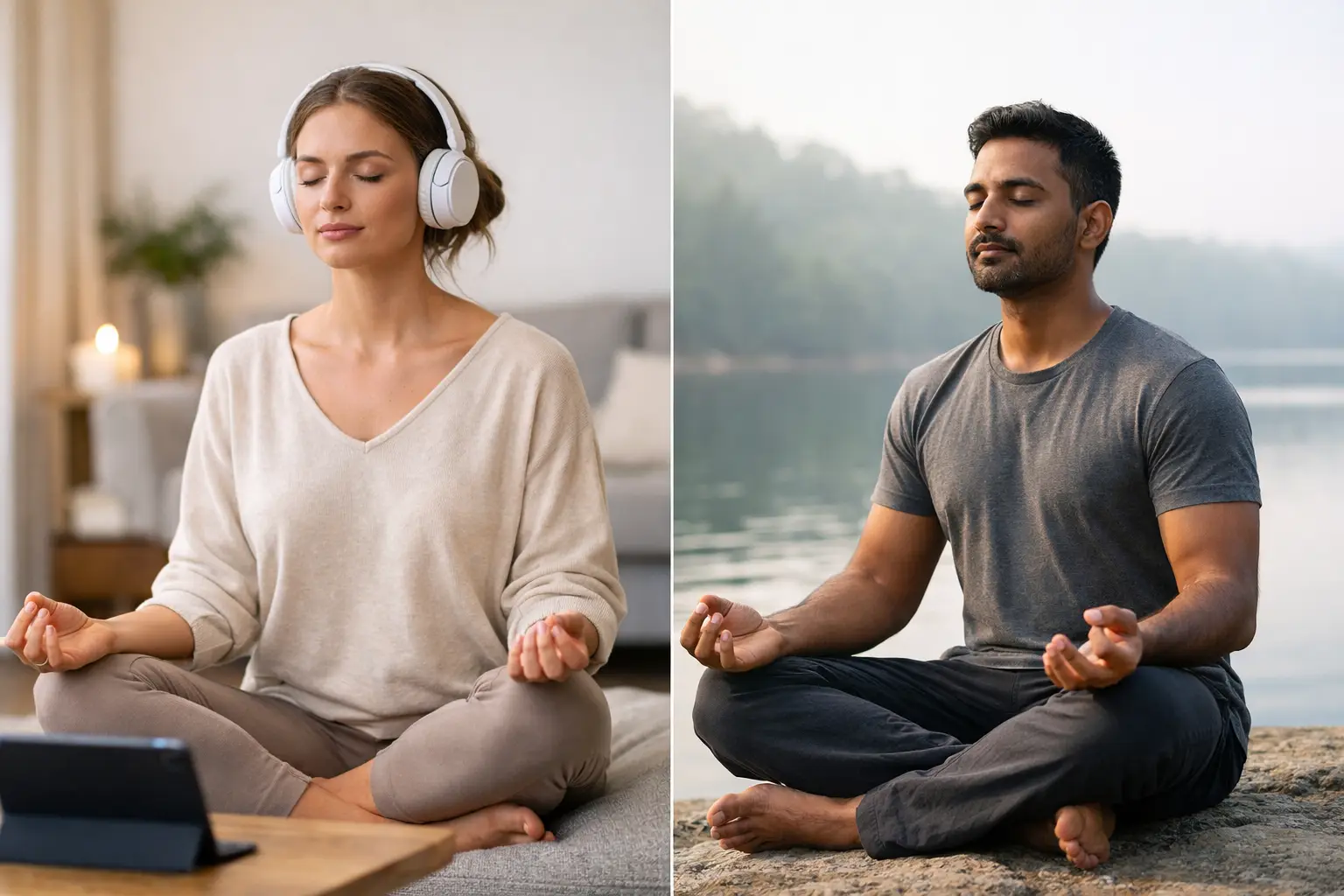
Some days, the mind does not want silence. It needs support. On other days, silence itself becomes the teacher. That is the real heart of guided meditation vs. self-meditation: not which one is better in theory, but which one helps you become quieter, gather your energy and return to your inner centre at this moment.
Many people begin meditation hoping for peace, only to discover restlessness, emotional movement, mental noise or simple uncertainty about what to do next. This is where the difference between guided and self-led practice matters. Each has value. Each serves a different stage of development. For many sincere seekers, the deeper path is not about choosing one forever, but about understanding what each form of practice can teach.
Guided meditation vs. self-meditation: the real difference
Guided meditation is practice with support. A teacher, facilitator or recorded voice gives structure to your attention. You may be led through breathing, body awareness, mantra, chakra focus, visualisation or energetic awareness. The guidance gives the mind a clear direction when it would otherwise wander.
Self-meditation is practice without external direction. You sit in stillness and work with your own awareness, breath, mantra, prayer or inner observation. The responsibility for remaining present rests increasingly with you.
On the surface, this looks like a simple difference in format. In practice, the inner experience can be very different. Guided meditation may feel containing, reassuring and accessible. Self-meditation can feel spacious, direct and revealing. One offers support from outside. The other gradually asks you to carry more of the practice from within.
Neither is spiritually superior by default. What matters is whether the practice is appropriate for your present condition and stage of development.
When guided meditation is the wiser choice
If you feel mentally or emotionally overloaded, guided meditation can be a gentler doorway. Many people come to meditation carrying pressure, tiredness, mental overactivity and emotional heaviness. In that state, being told simply to sit in silence can feel frustrating rather than helpful.
Guidance reduces the uncertainty of beginning. Instead of continually wondering what you should be doing, you are given a pathway to follow. This can help you settle more easily, remain with the practice for longer and gradually learn what inward attention feels like.
This can be particularly valuable if you are new to meditation, moving through an emotionally demanding period or returning to practice after a long interruption. A thoughtful guide can help you become more aware of the body, allow the breath to settle naturally and redirect attention when the mind becomes noisy.
There is also a deeper spiritual dimension. Within many spiritual traditions, the quality of the person guiding a meditation is considered important. Their experience, presence and depth of understanding influence how the practice is held and transmitted. This is one reason a meditation guided by an experienced teacher can feel very different from a generic recording.
The strengths of guided practice
Guided meditation offers structure, and structure can be valuable. It can help establish consistency and introduce principles or forms of awareness that may initially be difficult to practise alone.
For mantra practice, chakra awareness, subtle energetic work and deeper spiritual meditation, skilful guidance can help the practitioner approach the practice with greater understanding and discipline.
But guided meditation also has limits. If you become dependent on a voice, you may find it difficult to sit without external support. Some people remain in a passive role, continually following instructions without developing their own inner steadiness.
Guidance should therefore strengthen awareness, not replace it.
When self-meditation becomes essential
There comes a point when stillness must begin to be carried from within. This is where self-meditation becomes important.
Without a voice to follow, you begin to meet your own mind, habits, resistance and inner movement more directly. Self-led meditation develops steadiness and teaches you to remain with yourself without continually needing external input.
In self-meditation, you may work with a mantra, natural breath awareness, prayerful stillness, observation of thought or focused awareness within the Heart. The purpose is not to control every thought. It is to become increasingly conscious of what is taking place without automatically being carried away by it.
This form of practice can reveal where dependence still exists. If stillness is available only when someone else leads you into it, that stillness has not yet become fully established within you.
Self-meditation gradually invites the practitioner to develop an inner centre of awareness that can be carried beyond the meditation itself and into daily life.
The strengths of self-led practice
Self-meditation gives greater freedom and depth. You are no longer limited by a recording, another person’s pace or a fixed script. The practice can respond more directly to what is actually taking place within your consciousness.
It also develops maturity. You learn to begin without needing elaborate preparation, to return when the mind wanders and to remain with the practice whether the meditation feels quiet, restless, empty or profound.
This is not glamorous work. It is discipline.
At the same time, self-meditation can become vague when it is approached without sufficient foundation. A person may believe they are meditating while actually drifting into thought or daydreaming. Others may become overly effortful and turn meditation into another form of mental control.
Freedom requires foundation.
Which one is better for beginners?
For many beginners, guided meditation can be the easier starting point because it provides direction and reduces uncertainty.
But a healthy spiritual path should gradually develop the person’s own capacity to become quiet. Even short periods of silence following guided practice can begin to teach this.
In this way, the external guide becomes a bridge towards the inner guide.
If you feel overwhelmed, distracted or uncertain about how to begin, guided practice may be appropriate. If you have already developed some consistency and can remain inwardly present without constant direction, self-led meditation may become increasingly valuable.
The goal is not to remain dependent on one form.
The goal is development.
Guided meditation vs. self-meditation for spiritual growth
If your goal is only temporary calm, either method may have value. If your purpose is deeper spiritual development, however, the question changes.
You are no longer asking only, “How can I relax?”
You begin to ask, “How can I become more conscious?”
Guided meditation can support this movement by introducing deeper principles, disciplined inner attention, mantra, energetic awareness and devotional focus under appropriate guidance.
Self-meditation reveals how much of that practice has actually become yours. Can you become still without being continually carried by another voice? Can you observe the movement of the mind without immediately following it? Can you remain inwardly present when no one is directing you?
These questions reveal the degree to which the practice is becoming integrated.
For this reason, deeper spiritual practice can contain both guidance and periods of self-led meditation. Guidance can open the door and provide direction. Personal practice gradually teaches you to walk through that door yourself.
There is no universal schedule that suits everyone. The right rhythm depends on experience, readiness and the particular practice being followed.
How to choose what you need right now
Instead of asking only, “Which is best?”, ask:
What do I need to develop at this stage?
If you feel scattered, emotionally burdened or unable to become inwardly quiet, guided meditation may provide the structure you need.
If you can already remain still and want to deepen inner discipline, awareness and responsibility for your own practice, self-meditation may be the appropriate next step.
The choice can also depend on purpose. Guided meditation can be useful when you need structure, relaxation or a clear pathway into stillness. Self-led practice becomes increasingly important for discipline, inner listening and the gradual development of independent spiritual awareness.
Within IAMGODIAM, meditation is not treated as an isolated technique. It belongs to a wider path in which the physical, energetic, emotional, mental and spiritual aspects of the human being are understood as parts of one whole.
The deeper purpose is therefore not simply to become good at meditation.
It is to become more conscious.
A mature spiritual life is not rigid. Sometimes guidance is necessary. At other times, silence must be allowed to speak.
The teacher can show the way, but eventually the practitioner must learn to walk it.
And as that inner capacity develops, meditation gradually becomes more than something you practise for a period of time.
It becomes a way of returning towards the deeper Self.