Most people live much of their life from the outside in. They respond to work, money, relationships, expectations, fear, desire, memory and the continual pressures of the world around them. They may believe they are freely choosing, while many reactions are actually repetitions of patterns that have been developing for years.
This is one reason the question what are chakras and why do they matter? is more important than it may first appear. Within yogic and energetic traditions, the chakras are not merely colourful symbols or mystical ideas. They are subtle centres through which different dimensions of human life, energy and Consciousness are understood.
To study the chakras is therefore not simply to learn seven names and colours. It is to begin looking at the human being from the inside and asking where life feels grounded, where emotion becomes reactive, where power is being used consciously, where the Heart is open, where truth can be expressed and where awareness begins to move beyond the purely personal.
What Are Chakras?
The Sanskrit word chakra is commonly translated as “wheel” or “circle”. In the spiritual traditions of India, chakras are described as subtle energy centres associated with the movement of prana, or life force, and with different aspects of human and spiritual development.
They are not physical organs and should not be confused with anatomical structures. The chakra system belongs to a traditional subtle-body framework rather than to established modern anatomy.
A useful way to approach them is as centres through which different dimensions of human experience can be contemplated.
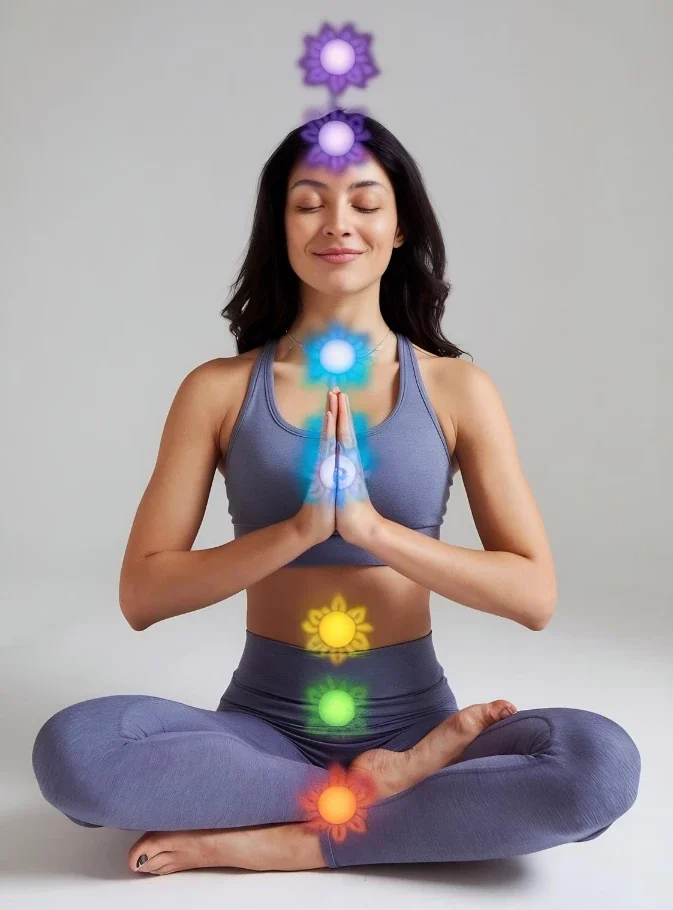
The lower chakras are closely associated with embodiment, grounding, life force, sexuality, emotion, power and the fundamental experience of being a human being. The Heart becomes a major turning point towards Love, compassion and mature relationship. The higher centres concern expression, inner seeing and the movement towards greater spiritual Consciousness.
Seen in this way, the chakras are not separate from everyday life.
They become relevant when fear affects grounding, when desire or power dominates choices, when emotion repeatedly controls reaction, when Love becomes guarded, when truth is difficult to express or when a person begins searching for a deeper spiritual orientation.
This is what makes chakra meditation and Chakra Healing meaningful within a spiritual path. They offer a map through which inner life can be observed rather than merely another collection of techniques.
Why Do Chakras Matter?
Many people attempt to change their lives almost entirely through thought. They read more, analyse more, plan more and promise themselves that next time they will react differently.
Yet the same pattern may return.
The same fear appears in another situation. A similar relationship problem is repeated. The same emotional reaction emerges under pressure. Someone who understands intellectually what they should do may still find themselves unable to live it consistently.
Within energetic traditions, the chakra system offers another perspective on these repetitions. It suggests that human experience is not understood only through conscious thought but also through emotion, instinct, habit, life force and subtler dimensions of awareness.
This does not mean that every problem proves that a chakra is “blocked”. Human difficulties can have physical, psychological, relational and practical causes, and these should never be ignored.
The chakra system becomes useful when it helps someone observe themselves more deeply.
Where am I grounded?
Where am I continually reacting?
Where do I surrender my power?
Where has the Heart become guarded?
Where am I afraid to express what is true?
Where is perception still distorted by fear, desire or expectation?
These questions turn the chakra system from a decorative spiritual idea into a practical form of self-observation.
The Seven Main Chakras
Many traditions describe numerous subtle centres, but the seven principal chakras have become one of the clearest maps for understanding the gradual movement from physical embodiment towards higher spiritual awareness.
Within IAMGODIAM, this movement is not understood as abandoning the lower centres in order to become spiritual. The lower foundation must become increasingly conscious and harmonious so that higher Consciousness can be carried through an actual human life.
The journey therefore begins with grounding.
It moves through life force and emotion.
It reaches a decisive turning point in the Heart.
From there, Love increasingly finds expression through truth, inner seeing and the movement towards Universal Love.
1. Root Chakra: Grounding, Stability and Physical Existence
The Root Chakra is the foundation of the seven-centre system. It concerns grounding, stability, physical existence and the capacity to inhabit human life rather than continually trying to escape from it.
Within traditional chakra teachings, difficulties associated with grounding may be explored through themes such as fear, instability, insecurity or disconnection from the body. These associations should be used as a spiritual map rather than as a diagnosis.
The Root asks very practical questions.
Can you remain present in your body?
Can you care for your physical foundation?
Can you meet ordinary life instead of continually seeking a spiritual escape from it?
Within some yogic traditions, the base of the subtle system is also associated with dormant kundalini. This is a deeper teaching and should not be approached casually or turned into an exercise in forcing energy upward.
For most people, the first spiritual task is much simpler.
Grounding comes first.
Higher spiritual practice needs a human foundation capable of carrying it.
2. Second Chakra: Life Force, Sexuality, Creativity and Power
The Second Chakra carries a powerful movement of life force. It is associated with sexuality, creativity, desire, relationship, pleasure, personal power and emotional movement.
This centre is important because human beings can be strongly moved by these forces without necessarily being conscious of them.
Desire can create.
Desire can also bind.
Power can protect and build, but it can also become manipulation or domination. Sexuality can belong to intimacy and creative life, while unconscious desire can pull a person into repetition or dependency.
The spiritual task is therefore not to deny life force.
It is to become conscious of it.
The Second Chakra invites questions such as: What moves me? Where do I give my power away? Where do I use power without Love? Which desires enrich life, and which continually control it?
This centre is not something to suppress in order to become “more spiritual”. Life force has to be understood, refined and carried consciously.
3. Third Chakra: Emotion, Reaction and the Human Mixture
The Third Chakra is often introduced simply as the centre of confidence and personal will. Within the IAMGODIAM understanding, it is more complex.
The first three centres form an interconnected lower foundation. Physical existence from the Root, life force and desire from the Second Chakra, and emotion and reaction in the Third Chakra continually influence one another.
The Third Chakra can therefore be understood as a kind of melting pot in which these different forces meet.
This is where survival, desire, personal power, fear, anger, ambition, uncertainty, pride and emotional reaction may combine in everyday human behaviour.
Most people do not consciously analyse these forces before every action.
They react.
A person may respond from fear while believing they are acting freely. They may seek control because uncertainty feels intolerable. They may pursue approval because something deeper feels insecure.
Modern life continually stimulates these lower patterns through money, status, sexuality, comparison, work pressure, insecurity, social approval and fear.
This does not mean that the world is deliberately manipulating every chakra. It means that many ordinary pressures act upon precisely those parts of human experience with which the lower centres are traditionally associated.
The Third Chakra therefore asks a profound question:
Am I choosing consciously, or am I being carried by forces I have not yet recognised?
4. Heart Chakra: Love, Compassion and Mature Humanity
The Heart Chakra is the central turning point in this path.
Within IAMGODIAM, the Heart is especially important because it represents far more than sentiment or pleasant emotion. It is connected with Love, softness, affection, care, listening, compassion, understanding, protection and mature human relationship.
The Heart can embrace another person without losing discernment.
It can be soft without becoming weak.
It can protect truth without becoming hard.
It can Love without needing to possess.
This is why the Heart cannot simply be placed beside the other chakras as one centre among seven. It represents a profound movement in the development of the human being.
The lower forces do not disappear when the Heart awakens. Body, desire, life force and emotion remain, but they can increasingly come under the influence of Love.
Power without Heart can become hardness.
Emotion without Heart can become self-absorption.
Truth without Heart can become cold.
Spirituality without Heart can become distant from actual human life.
Within IAMGODIAM, the soul is understood as the core of Love.
And when that Love is increasingly lived outwardly, it becomes freedom.
Not freedom as simply doing whatever the personality wants, but freedom from being continually governed by fear, unconscious reaction and separation.
5. Throat Chakra: Truth and the Expression of Love
The Throat Chakra concerns expression, communication, vibration and truth.
But expression is not merely speaking.
People can speak continually without expressing anything deeply true. Words may come from fear, defence, pride, pain or the desire to control how others see us.
The deeper development of the Throat begins when what has become conscious in the Heart can move outward through expression.
Love then becomes capable of speech.
Truth becomes capable of expression without unnecessary violence.
Silence itself can become meaningful when it is conscious rather than fearful.
Within chakra work, difficulties around the Throat may therefore be explored through themes such as suppressed expression, fear of speaking, dishonesty, excessive talking or the inability to communicate what is genuinely felt.
These associations are not diagnoses. They are invitations to observe.
The deeper question is whether your outer expression increasingly corresponds with what you know inwardly to be true.
6. Third Eye Chakra: Inner Seeing and Discernment
The Third Eye is associated with awareness, insight and inner seeing.
This should not be reduced to fantasy, supernatural performance or the desire to collect unusual spiritual experiences.
True seeing begins much closer to home.
Can you see your own patterns clearly?
Can you recognise when fear is influencing perception?
Can you distinguish intuition from desire?
Can you recognise the difference between what someone says and what their actions repeatedly reveal?
Can you see beyond the immediate emotional reaction towards the larger pattern?
This kind of awareness develops together with discernment and humility.
The purpose of the Third Eye is not to make someone feel spiritually superior. Greater perception should make the person more responsible because they become increasingly aware of the consequences of thought, speech and action.
As seeing becomes clearer, unconscious repetition becomes harder to maintain.
Awareness opens the possibility of different action.
And different action gradually creates a different life.
7. Crown Chakra: Surrender and Universal Love
The Crown Chakra is the highest of the seven principal centres and is associated with surrender, spiritual Consciousness and the relationship with a greater reality beyond the isolated personality.
Within IAMGODIAM, this movement ultimately opens towards Universal Love.
This should not be understood as escaping the world or rejecting individuality. The purpose is not to become less human.
It is to allow a deeper Consciousness to become increasingly present through human life.
At this level, Love is no longer understood only through personal preference. The relationship with life begins to widen.
The question gradually changes from:
What do I want from life?
to something deeper:
What is life asking me to become capable of expressing?
Surrender in this context does not mean passivity.
It means becoming less governed by the narrow demands of the personal self and more capable of living in alignment with a greater spiritual reality.
Chakra Healing Is Not Decoration
Modern chakra language can sometimes become very superficial. Colours, crystals, visualisations and affirmations may all be used within spiritual practice, but none of these is the essence of the chakra path.
The important question is not simply:
What colour belongs to this chakra?
The deeper questions are:
What repeatedly happens in this area of my life?
Where am I still reacting automatically?
Where have I surrendered my power?
Where has the Heart become guarded?
Where am I afraid to speak truth?
Where am I not seeing clearly?
Where am I trying to control what eventually needs to be surrendered?
Chakra Healing becomes meaningful when it leads towards this kind of awareness.
The Root may bring attention towards grounding and fear.
The Second Chakra may reveal unconscious relationships with desire, sexuality or power.
The Third may expose repeated emotional reactions.
The Heart may show where Love has become guarded.
The Throat may reveal where expression lacks truth.
The Third Eye may challenge distorted perception.
The Crown may confront the limits of the purely personal will.
These are spiritual correspondences, not fixed diagnoses.
Their value lies in what they help you become conscious of.
Why Chakras Matter for Modern Life
Modern life continually pulls attention outward.
Phones, work, news, money, social media, opinions, conflict and endless streams of information can occupy awareness from the moment someone wakes until the moment they sleep.
People can therefore become extraordinarily informed about the outer world while knowing very little about their own inner condition.
The chakra system reverses that direction of attention.
It asks you to look inward.
Where do I feel grounded?
Where am I losing energy?
Where does emotion repeatedly govern my behaviour?
Where has Love become difficult?
Where am I withholding truth?
Where am I unable to see without distortion?
What is my relationship with something greater than my personal concerns?
These are not small questions.
They return attention towards the human being who is actually living the life.
Within IAMGODIAM, this movement eventually leads towards the soul.
Everything that truly lives longs to return to its core.
The deepest human core is not continual fear, pressure or survival.
Within the IAMGODIAM spiritual understanding, the soul is the core of Love.
Chakras, Meditation and Real Transformation
Meditation helps because it creates enough stillness for patterns that are usually hidden by continual activity to become visible.
You may notice physical tension, emotional unrest, repetitive thinking, fear, sadness, desire or resistance. Something that has been influencing life for years may become obvious only when you finally stop moving long enough to observe it.
This is one way transformation begins.
Not by immediately trying to fix everything.
Not by forcing a chakra to open.
Not by pretending that every spiritual practice must feel peaceful.
It begins through seeing.
Chakra meditation can bring conscious attention towards different dimensions of the energetic system, but what becomes visible must eventually be carried into ordinary life.
If fear becomes visible through work with grounding, the deeper task is not merely to visualise the Root Chakra more strongly. It is to understand how fear is influencing life.
If the Second Chakra brings questions of powerlessness into awareness, you may need to examine where power is repeatedly being surrendered.
If the Third reveals habitual reaction, the task is to stop confusing reaction with freedom.
If the Heart reveals pain, the work may involve allowing Love to become possible again without abandoning boundaries or truth.
If the Throat reveals suppressed expression, something may need to be spoken.
If the Third Eye reveals distortion, discernment must develop.
If deeper spiritual Consciousness begins to call, surrender eventually becomes part of the path.
This is the difference between being interested in chakras and actually working with them.
Final Reflection
So, what are chakras?
Within yogic and energetic traditions, they are subtle centres associated with different dimensions of human energy, awareness and spiritual development.
And why do chakras matter?
Because they provide a map through which the human being can become more conscious of grounding, life force, emotion, personal power, Love, expression, inner seeing and spiritual surrender.
They should not be treated as medical anatomy or used to explain every problem in life.
Their deeper value is as a mirror.
A mirror can show where you are grounded and where you are unstable.
Where you are choosing and where you are reacting.
Where Love flows and where it has become guarded.
Where truth is expressed and where it remains hidden.
Where perception is clear and where fear or desire still colours what you see.
The purpose is not to become fascinated with seven chakras.
The purpose is to become a more conscious human being.
Within IAMGODIAM, that path moves from grounding through the lower human foundation, towards the Heart, greater awareness and ultimately Universal Love.
The chakras are therefore not the destination.
They are part of the map.
The deeper destination is a human being whose body, energy, Heart, mind and Consciousness increasingly live in harmony, so that the Love of the soul can find expression in ordinary life.