
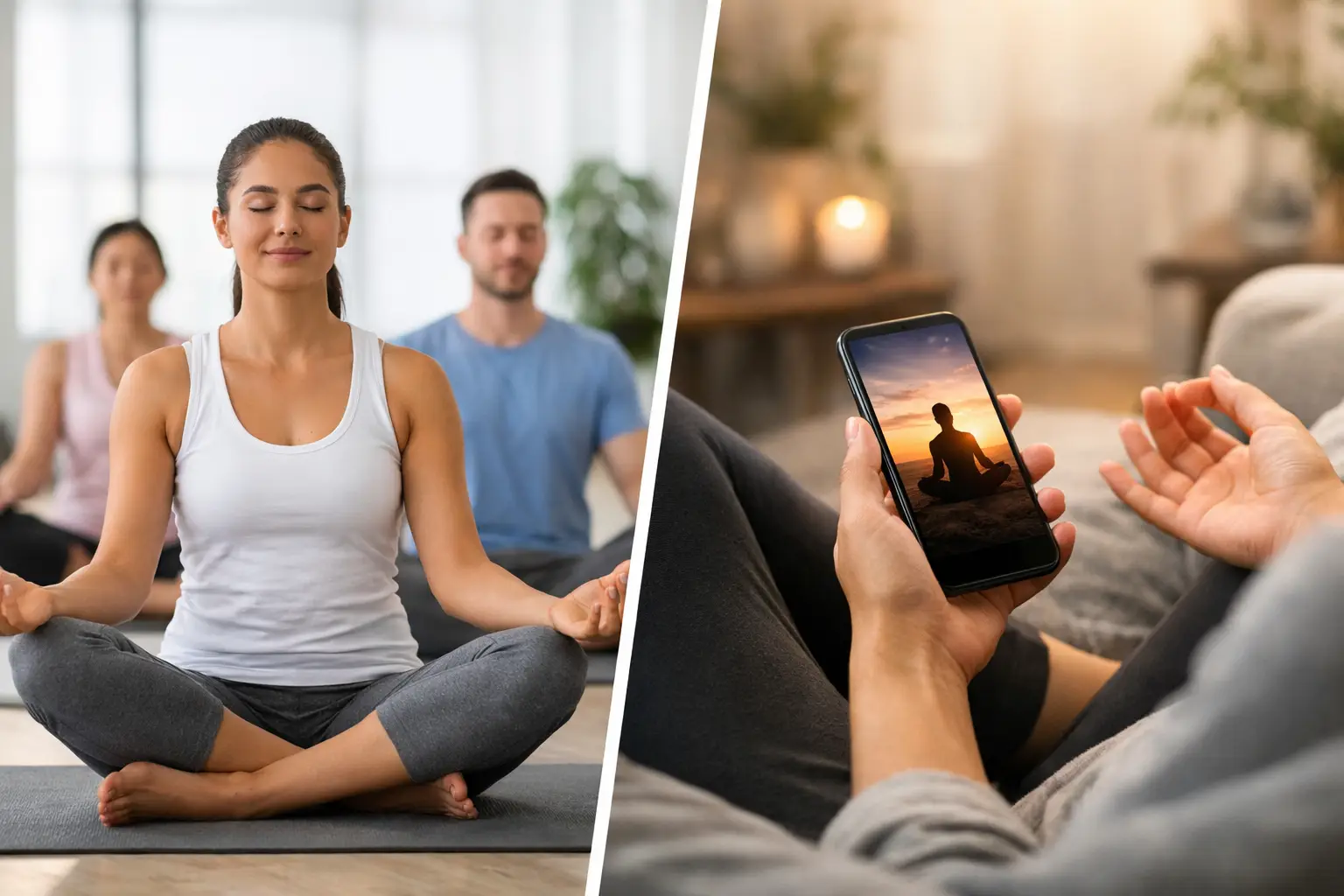
A meditation app can help you breathe for ten minutes before a meeting. A real teacher or structured meditation path can help you understand why the mind continually returns to the same fear, tiredness or inner restlessness. That is one of the deeper differences in meditation classes vs apps. One primarily offers convenience and content, while the other can offer context, guidance, structure and a progressively deeper understanding of practice.
If you feel emotionally overloaded, inwardly disconnected or simply tired of using meditation only as a temporary reset, this distinction matters. Not every form of meditation support serves the same purpose. Some tools help create a moment of quiet, while deeper guidance can gradually teach you how to carry awareness into the rest of your life.
Meditation classes vs apps: the real difference
The simplest way to understand meditation classes vs apps is that an app usually provides content, while guided teaching provides relationship, structure and the possibility of personal clarification.
A meditation app is designed for broad use. It may offer timers, breathing exercises, sleep recordings and themed sessions for stress, focus or relaxation. This can be useful, particularly for beginners who need an accessible starting point. You open the app, choose a practice and begin.
A guided meditation setting is different because there is a teacher or practitioner behind the practice. Questions can be answered, misunderstandings can be corrected and the method can be placed within a wider path rather than remaining an isolated recording.
Meditation is not only a technique. As awareness develops, people may become more conscious of emotion, resistance, mental habits or deeper spiritual questions. An app can provide another recording, but it cannot personally respond to what is arising within an individual. Experienced guidance can help place those experiences in context.
When apps work well
Apps are not the enemy. For some people, they are a useful doorway into meditation.
If your schedule is unpredictable, an app makes it possible to practise without arranging a particular time with another person. If you are completely new to meditation and feel uncertain about beginning, a simple recording may offer enough structure to help you sit quietly for the first time.
Repetition can also be valuable. Returning to the same simple breathing or relaxation practice can help establish a rhythm, and regularity is often more useful than continually changing methods.
The limitation is that apps are necessarily created for many different people at once. They cannot know your constitution, your emotional condition, your level of experience or what you genuinely need to develop. They may therefore be useful as tools, but they should not automatically be mistaken for a complete spiritual path.
Meditation can become much more than a transformational discipline delivered through a collection of recordings. Deeper development eventually asks for understanding, continuity and personal responsibility.
Where meditation classes go deeper
A well-guided meditation environment can create more than temporary relaxation. It can provide a coherent path.
Instead of choosing randomly from hundreds of recordings according to mood, the practitioner follows a practice with a purpose. Depending on the path, this may include breath awareness, concentration, mantra, chakra awareness, energetic work or spiritual teaching that helps place meditation within a larger understanding of the human being.
This is where guidance becomes valuable. A person can ask questions and receive clarification. They can learn why one practice feels grounding while another creates restlessness, and why a technique that is appropriate at one stage may not be appropriate at another.
The purpose is not to make meditation complicated. It is to prevent the practitioner from continually guessing.
For someone seeking more than short periods of calm, structure and continuity can become important. Meditation then begins to develop from an occasional wellness activity into a real inner discipline.
Why guidance changes the experience
Meditation looks simple from the outside. Sit down, close the eyes and become quiet. Inner practice is rarely quite that simple.
Some people become sleepy almost immediately. Others become restless. Some experience emotional release, while others feel very little and assume they are doing something wrong.
Experienced guidance can help a practitioner understand that different experiences do not automatically mean success or failure. More importantly, it can help determine whether the method itself is appropriate for the person and their present stage.
Someone who is highly agitated may need more grounding and structure before practising long periods of silence. Someone who is depleted may first need to look at the wider conditions of daily life rather than simply adding more meditation. Someone with an established foundation may gradually become ready for deeper mantra or spiritual practice.
This is one reason some practitioners eventually outgrow apps. As the inner life becomes more subtle, generic content may no longer provide sufficient context.
Meditation classes vs apps for stress, healing and growth
If your purpose is basic relaxation, either option may have value. If your purpose is deeper spiritual development, however, the difference becomes more important.
Apps frequently organise practices around immediate needs such as sleep, focus, anxiety or relaxation. There is nothing wrong with that, but these are not the whole of meditation.
A deeper approach begins to ask wider questions. What is creating the continual mental movement? What patterns are repeatedly pulling attention outward? What needs greater grounding? What is the relationship between the body, energy, emotion, mind and Consciousness?
Meditation then becomes part of learning to understand and govern the inner life rather than merely calming it for a short period.
The result should not be measured through promises of better sleep, stronger energy or emotional transformation after a fixed number of sessions. The more meaningful question is whether the practitioner is gradually becoming more aware, more stable and increasingly capable of carrying that awareness into ordinary life.
Accountability is a support, not a small detail
One advantage of structured guidance is that it creates rhythm.
An app remains available whenever you decide to use it. A structured practice asks you to make a conscious place for meditation in your life. That difference can matter because spiritual discipline develops through continuity rather than inspiration alone.
When a person practises only when they feel like it, meditation can easily remain dependent upon mood. A more consistent rhythm gradually teaches the practitioner to sit even when the mind is restless, distracted or uninterested.
This does not require dependency upon a teacher or group. The purpose of external structure is eventually to help establish internal discipline.
Guidance should gradually make you stronger in your own practice, not less capable without it.
The hidden limitation of app-based meditation
There is another limitation that deserves attention. Meditation can easily become another form of digital consumption.
A person may continually search for the perfect voice, the perfect sound, the perfect length or the next new meditation. The search itself can become another form of restlessness.
Real meditation asks for something different. It asks for presence, honesty, discipline and a willingness to remain with what is actually there.
Technology can support this, but it can also encourage continual choice. If every meditation becomes another item in a library to browse, depth can easily be replaced by variety.
This does not make apps harmful. It simply places them in their proper role.
They are tools.
They are not the path itself.
So which should you choose?
The answer depends upon what you genuinely need at this stage.
If you want an accessible way to begin, an app may be useful. It can introduce simple breathing, relaxation and basic awareness practices and help you become accustomed to sitting quietly.
If you are looking for greater depth, clarification and a spiritually grounded path, experienced guidance is likely to become more important. The value lies not simply in having another person present, but in having a coherent practice that develops progressively rather than remaining a collection of unrelated techniques.
Some people may use both. A recording can remain a practical support, while deeper practice is grounded in real understanding and appropriate guidance.
The important thing is not to become dependent upon either.
Within IAMGODIAM, meditation is not approached as a quick fix or as an isolated technique. It belongs to a broader path in which grounding, energy, Consciousness, the Heart and the relationship with the Higher Self are progressively developed.
Stress relief can be a valuable beginning, but it is not the whole purpose of meditation. At a deeper level, practice gradually teaches you to become conscious of what moves within you and to return towards the deeper Self.
Choose the support that helps you develop rather than merely consume another meditation. The best method is not necessarily the one with the largest library or the most impressive promise. It is the one that gradually helps you become capable of carrying greater awareness within yourself and into the ordinary life you live every day.