
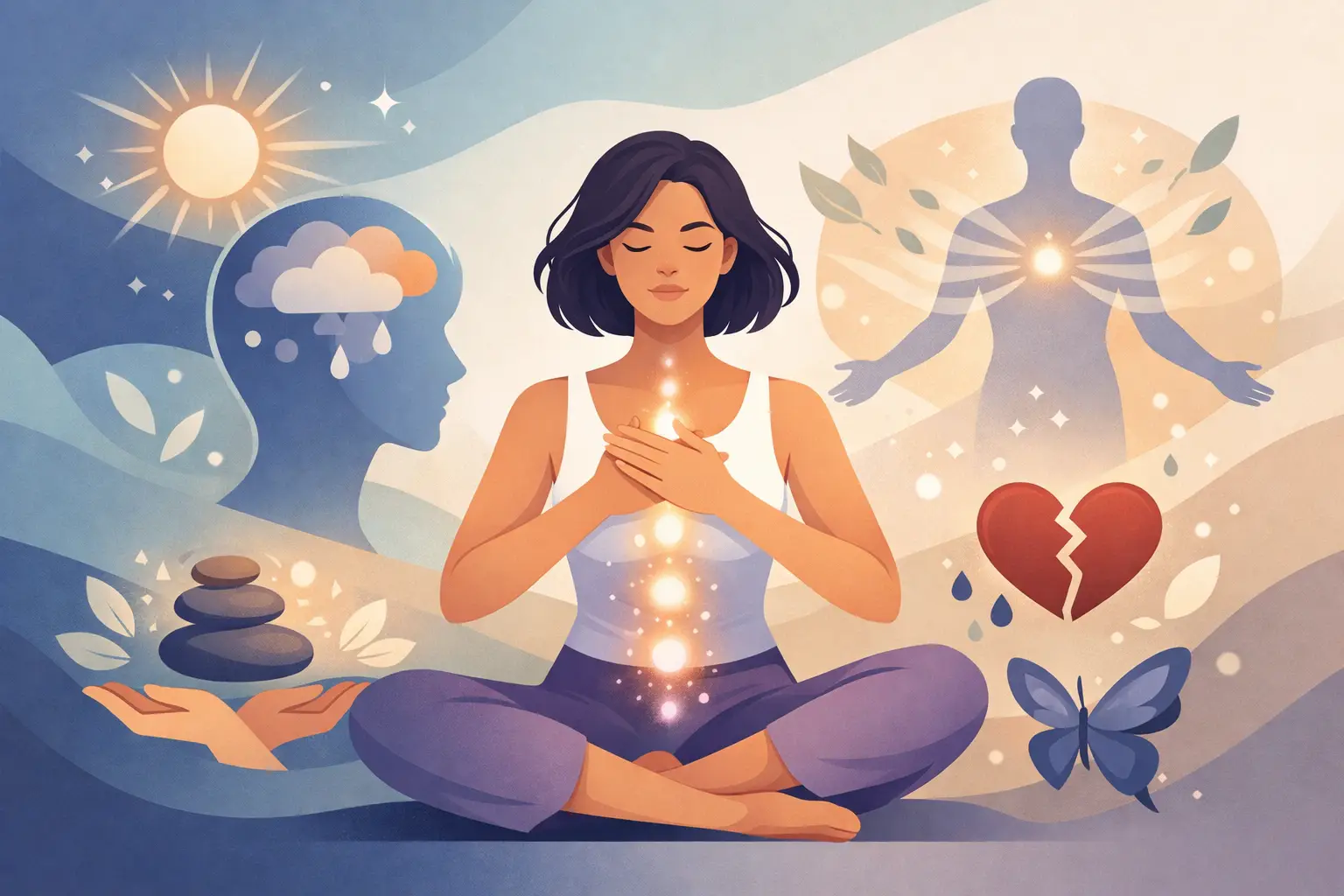
Some emotional pain does not disappear simply because you understand where it came from. You may know why you feel anxious, heavy, reactive or depleted and still recognise that the same pattern continues to influence your life. This is where energy healing and emotional release can become meaningful within a wider spiritual approach. Mental understanding matters, but human experience also involves the body, emotions, breath, energy and Consciousness.
For many people, emotional strain is experienced through more than thought alone. Breathing may become tense, the body may remain guarded and meditation may feel difficult because the inner world is crowded with unresolved feeling. Energetic work offers another way of approaching this experience, not by forcing emotion to disappear, but by creating greater awareness of what is still being carried.
What energy healing emotional release really means
Within IAMGODIAM, emotions are not treated as isolated events. They influence the way a person thinks, reacts, relates and carries energy through daily life. Energetic traditions also understand emotional experience through the aura, chakras, prana and the wider subtle system.
When a difficult experience has not been fully understood or integrated, its effects may continue long after the original event. This does not mean that an emotion is literally stored in one physical location waiting to be removed. It means that emotional experiences can continue through memory, habitual reaction, tension, behaviour and, within an energetic framework, patterns in the subtle field.
These patterns may appear quietly. A person may notice difficulty trusting, repeated irritation, emotional numbness, tiredness or the feeling that they have moved away from their deeper Self. The original event may have passed, but something in the way it is being carried remains active.
Within IAMGODIAM, energetic work may include meditation, breath awareness, Aura Healing, Chakra Healing and work with Source Energy and Universal Energy. The purpose is not to force a person to relive suffering. It is to support greater harmony and awareness so that what has remained unresolved can gradually be approached more consciously.
Why emotions can seem to remain in the body and energy field
Difficult emotional experiences can continue to influence the human being in many ways. Grief, fear, anger or disappointment may affect sleep, breathing, concentration, relationships and the way someone responds to situations that resemble an earlier experience.
Within energetic traditions, these continuing patterns may also be understood as disturbances in the movement of life force or in the relationship between different parts of the subtle system. This is a spiritual framework rather than a medical explanation, and the distinction is important.
Someone who continually suppresses what they need to say may, for example, become more conscious of tension while working with the throat centre. A person carrying grief may experience the Heart as guarded or closed, while emotional pressure may be strongly felt in the lower energetic centres.
These correspondences can be useful for spiritual exploration, but they should not become rigid diagnoses. Physical discomfort, digestive difficulties, tiredness or other symptoms can have medical causes and should be assessed appropriately where necessary.
The value of energetic work lies in adding another level of understanding without pretending that every symptom has an energetic origin.
Signs you may need emotional release work
You do not need to be in crisis before exploring this kind of healing. Sometimes the indication is simply that the same emotional pattern keeps returning despite considerable reflection.
You may understand intellectually why something affects you and still find yourself reacting in the same way. Meditation may continually bring attention back to one unresolved area. You may feel inwardly heavy or recognise that a particular relationship, fear or memory still carries more power than you would like it to have.
Emotional numbness can also deserve attention. Not everyone struggling emotionally appears overwhelmed. Some people become highly functional precisely by becoming less aware of what they feel.
They may work, communicate and care for others while remaining inwardly disconnected from tenderness, grief, joy or the deeper Heart.
In these situations, healing does not need to begin with dramatic emotional expression. It may begin with stillness, greater honesty and the simple recognition that something within has not yet been fully faced.
If mental understanding has taken you as far as it can, another form of support may help. This might be energetic work, deeper meditation, psychological support or a combination appropriate to the individual.
What happens during energy healing emotional release
Every person enters energetic work with a different history, constitution, level of sensitivity and capacity to carry deeper inner experience. There is therefore no single response that everyone should expect.
Some people report warmth, tingling, emotion, changes in breathing or a deep sense of quietness. Others feel very little during a session and only later recognise that something has become clearer.
Neither response proves that healing has or has not occurred.
Tears do not automatically mean that stored emotion has been released. Tingling does not prove that energy has moved through a particular chakra. Feeling tired afterwards does not necessarily mean the system is integrating a major energetic change.
These experiences may still be meaningful, but their meaning should emerge through careful observation rather than immediate interpretation.
Energetic work should also respect what the individual can carry. More intensity is not automatically more healing. When emotional material becomes overwhelming, the appropriate response may be to slow the process, return to grounding or seek another form of professional support.
Timing matters.
A mature spiritual path does not force open what the person is not yet ready to integrate.
The role of chakras in emotional release
Chakra Healing can provide a useful energetic map through which emotional and spiritual patterns are explored. No human experience belongs entirely to one chakra, and the seven principal centres should always be understood as one interconnected system.
The Root Chakra is associated with grounding, stability and physical existence. The Second Chakra carries life force, sexuality, creativity, personal power and emotional movement. The Third Chakra is closely connected with emotion, reaction and the way different lower forces are brought together within ordinary human experience.
The Heart Chakra occupies a particularly important place. It carries Love, compassion, softness, care, affection and the deeper capacity to embrace another human being while remaining rooted in truth.
The Throat Chakra relates to expression and truth. The Third Eye relates to awareness and inner seeing, while the Crown opens towards greater Consciousness and the relationship with Universal Love.
A disturbance may appear more strongly through one centre, but working only with that chakra is not always sufficient. What looks like a Heart issue may also involve grounding, personal power or expression. What appears to be a third-eye problem may actually be connected with exhaustion or emotional overload.
This is why a whole-person approach can be valuable. Meditation may help quiet the mind, while Chakra Healing works with the energetic dimension. Ayurveda supports the physical foundation through food, digestion, elimination, rhythm, rest and conscious living.
The deeper work is not to isolate these levels but to understand how they belong together.
What to expect after a session
There is no universal experience that should follow energetic healing.
You may feel lighter, quieter or more reflective. You may become aware of emotion that was already present. You may simply feel tired, or you may notice very little at all.
None of these responses should automatically be interpreted as proof that energy has been released or that the healing is continuing through a predetermined integration period.
It is better to observe yourself without trying to turn every sensation into a spiritual event.
Ordinary support is often enough afterwards. Drink water according to your normal needs, eat nourishing food, rest if you are tired and allow some quietness if that feels appropriate. Meditation or gentle breath awareness can also help you remain consciously present.
If physical or psychological symptoms become unusual, severe or persistent, do not explain them away as part of emotional release. Appropriate medical or psychological care should be sought when needed.
Healing and discernment belong together.
When energy healing helps most and when it depends
Energetic healing may be meaningful for people carrying stress, grief, emotional burden, spiritual disconnection or recurring patterns that they feel have not been resolved through mental understanding alone.
It can also work alongside meditation, Ayurveda, appropriate psychological support and conscious changes in daily life. Different forms of healing do not have to compete with one another.
The appropriate depth and method depend upon the person.
Someone may first need grounding, sleep and greater daily stability. Another person may be ready for deeper meditation or energetic work. Someone else may need professional therapeutic care before intensive spiritual practices are appropriate.
There is no wisdom in giving the same treatment to everyone simply because the visible symptom appears similar.
Within IAMGODIAM, meditation, Aura Healing, Chakra Healing, energetic work, Ayurveda and conscious living are therefore approached as interconnected aspects of the whole human being. The purpose is not to produce temporary emotional intensity, but to support a longer movement towards greater awareness, balance and relationship with the deeper Self.
How to support your own emotional release process
You do not need to force emotion in order to heal.
Begin by creating enough quietness to recognise what is actually present. Sit for a few minutes, become aware of your breathing and notice where the body feels tense or tired without immediately trying to change it.
If emotion arises, allow yourself to recognise it without suppressing it and without deliberately making it stronger.
Regular meditation can help develop greater awareness. Conscious breathing can bring attention back into the present. Mantra and spiritual practice may support deeper inner orientation, while regular sleep, nourishing food, sufficient water, rest and a steadier daily rhythm provide the physical foundation through which deeper work must ultimately be carried.
But spiritual practice does not remove personal responsibility.
Guidance can help you see.
Energy healing can support you.
Meditation can help you become quiet enough to recognise what is happening.
But you must also do the work yourself.
You may need to establish a boundary, change a habit, speak a truth, forgive without returning to an unhealthy situation or stop continually rebuilding a pattern that you already know causes suffering.
That is where emotional release becomes more than an experience during healing.
It becomes change.
As the burden of old patterns gradually becomes lighter, greater clarity and inner freedom may begin to appear in ordinary life. Not because every difficult emotion has disappeared, but because you are increasingly capable of carrying emotion without losing your relationship with the deeper Self.
If something old still feels present in your Heart, your thoughts, your reactions or the way you live, that awareness itself can be important.
Healing does not begin by forcing it away.
It begins by becoming conscious enough to stop continually giving it new life.