
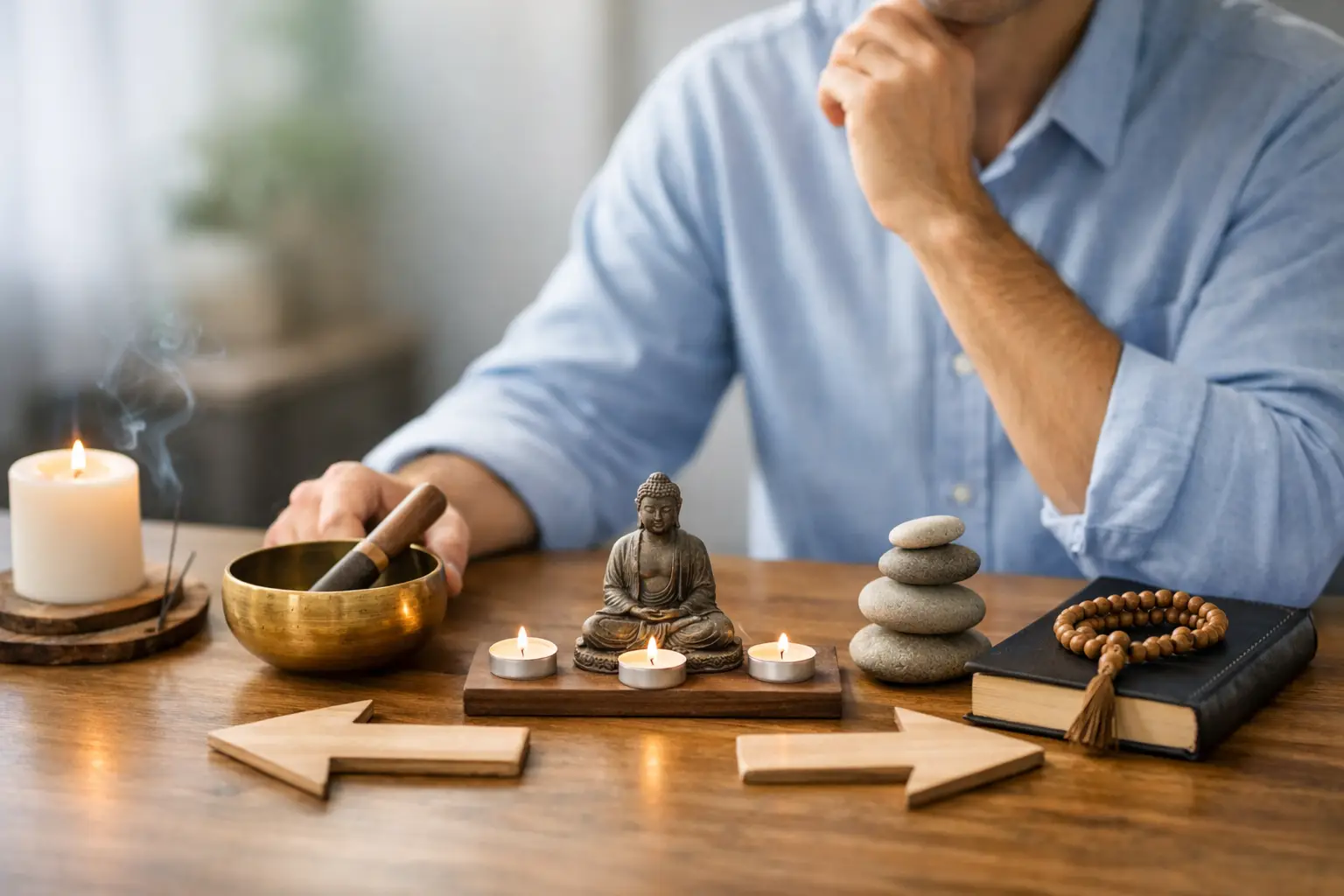
Some people begin with meditation because they feel anxious or mentally overloaded. Others begin looking for a spiritual path after exhaustion, grief, confusion or a quiet sense that something essential is missing. If you are asking how to choose spiritual practice, the real question is not which method is most popular. It is which practice is appropriate for where you are now and can genuinely support your next step.
That distinction matters. A spiritual practice should not become another task through which you judge yourself or feel inadequate. It should gradually help you develop greater steadiness, awareness, inner clarity and a deeper relationship with yourself and life.
The right practice does not always feel easy.
But it should have meaning.
Why choosing the right spiritual practice matters
Not every practice serves the same purpose, and not every practice is appropriate for every person or every stage.
Breathing practices may help one person become quieter while another may find certain intensive techniques too activating. Silent meditation can be valuable for someone who already has inner stability, while a beginner with a very active mind may initially need more structure.
Mantra can provide a strong point of inner direction. Energetic healing may be appropriate for someone who first needs support at another level. Body awareness may help a person who spends almost all of life in thought.
This is where many people become confused.
They assume spiritual growth means finding the most powerful or advanced method and forcing themselves to practise it.
But deeper spiritual development requires readiness.
A good spiritual practice meets you where you are and then gradually asks you to grow. It respects both the human being you are today and the deeper potential you carry within.
How to choose spiritual practice based on your real need
Begin with a simpler question than:
“What is the best spiritual practice?”
Ask instead:
What do I need to develop at this stage?
If your mind is restless and overstimulated, grounding and structured practices may be more appropriate than highly activating ones. Gentle meditation, conscious breathing or a suitable mantra can provide a clear point of return.
If your energy feels depleted, it may be useful first to look at the wider conditions of your life: sleep, food, rhythm, emotional pressure, physical activity and the amount of continual stimulation you are carrying.
If you are emotionally burdened, spiritual practice should not become a way of avoiding what you feel. A practice that includes guidance, awareness or appropriate healing support may help you approach your inner life more consciously.
If you have outward stability but inwardly feel disconnected from meaning, a more sacred practice involving devotion, meditation, mantra or contemplation may speak to something deeper.
Your first need may simply be greater calm.
That is a valid beginning.
But sometimes what appears as stress is connected with a wider pattern of exhaustion, scattered attention, emotional pressure or disconnection from the deeper Self.
A wise practice does not merely cover what is happening.
It helps you become conscious of it.
Look at your starting point honestly
Beginners are often attracted to advanced spiritual teachings because they sound powerful.
But advanced does not automatically mean appropriate.
A practice should correspond to the capacity of the person who is carrying it. Deeper knowledge given before sufficient foundation has been established may create confusion rather than development.
There is no weakness in beginning simply.
A short practice carried consistently can teach far more than an advanced method practised without understanding, preparation or continuity.
If you already have a strong foundation, you may gradually be ready for a path that brings together deeper meditation, energetic work, spiritual study and greater inner responsibility.
Simplicity, when lived deeply, becomes depth.
Match the practice to your temperament
People approach spiritual life differently.
Some are naturally devotional. Prayer, mantra, gratitude and reverence open something within them.
Others are contemplative and are drawn towards silence, observation and inner enquiry.
Some people are highly sensitive to energetic experience and naturally respond to chakra work, healing or subtler forms of awareness.
Others need grounding in the body and ordinary life before working with more subtle practices.
Your temperament matters.
If you continually force yourself into a practice that feels completely disconnected from your nature, you may eventually decide that spiritual practice itself has no value for you.
Sometimes the problem is simply that you entered through the wrong doorway.
At the same time, do not confuse resonance with comfort.
A genuine practice may challenge your habits, expose resistance and ask for discipline.
The question is not:
“Does this always feel pleasant?”
The better question is:
“Is this helping me become more conscious?”
Signs a practice fits you
A suitable practice should gradually bring greater order rather than increasing fragmentation.
You may begin to notice that you recognise your reactions earlier. You may become more capable of remaining present. The mind may become less scattered. You may begin to feel a stronger relationship with your own inner life.
The effects do not need to be dramatic.
Authentic spiritual development is often quiet.
The measure is not whether every meditation produces peace, light or an extraordinary experience.
The measure is whether something is gradually becoming more conscious.
Choose depth over trends
Modern wellness culture can make spiritual practice look like a collection of constantly changing techniques.
One week it is breathwork.
The next week it is sound.
Then manifestation.
Then another method promises a faster path.
Many practices can have value, but continual switching can prevent depth.
A true spiritual practice develops through relationship, repetition, understanding and lived experience. Over time, it begins to influence not only what happens during meditation but also how you think, speak, eat, rest, work, relate and respond to other people.
This is why coherent paths have value.
Meditation, Ayurveda, mantra, chakra work and sacred spiritual disciplines were not originally created as disconnected wellness tricks. Each belongs to a larger understanding of the human being.
That does not mean you need to practise everything.
It means the pieces should make sense together.
Choose coherence rather than novelty.
The role of guidance in spiritual growth
A person can begin many simple practices independently, but deeper spiritual development often benefits from experienced guidance.
A teacher or practitioner can help you understand what belongs to the foundation, what should come later and where you may be confusing resistance with genuine incompatibility.
This becomes increasingly important as practices become deeper.
Someone carrying considerable emotional pressure may not first need a more demanding spiritual discipline. They may need grounding and greater stability.
Someone who continually moves from one teaching to another may need the opposite: less searching and more continuity.
Experienced guidance can help distinguish these things.
But a trustworthy guide should never make you dependent.
The purpose of genuine guidance is to help you develop discernment, awareness and increasing responsibility for your own path.
The teacher can show the way.
The practitioner must learn to walk it.
Questions to ask before you commit
Before choosing a spiritual practice, ask yourself a few honest questions.
What do I genuinely need to develop now?
Can I practise this with reasonable consistency?
Does this path have depth and integrity, or does it mainly make large promises?
Does it help me become more present and responsible in ordinary life?
Am I being encouraged to develop, or simply to depend upon another person, technique or experience?
These questions are more valuable than following what happens to be popular online.
Be especially discerning with teachings that promise instant awakening, guaranteed healing or rapid spiritual mastery.
Real spiritual development does not remove you from human life.
It teaches you to live it with greater Consciousness.
A simple way to begin
If you are uncertain, begin with one appropriate foundational practice and remain with it long enough to understand what it actually does.
Do not change techniques every few days simply because another method appears more interesting.
Create a rhythm.
Practise consistently.
Observe honestly.
You may begin with meditation, a suitable mantra, conscious breathing, body awareness or another simple practice appropriate to your present stage.
Do not continually measure the practice through dramatic experiences.
Look instead at your life.
Are you becoming more aware of your thoughts?
Do you recognise emotional reactions earlier?
Are you becoming more grounded?
Are you developing greater discipline and inner clarity?
If the practice continually creates confusion, agitation or imbalance, it may need to be adapted or reconsidered with appropriate guidance.
For many people, development eventually becomes broader than a single technique.
Meditation works with awareness. Energetic healing approaches the subtler energetic condition of the human being. Ayurveda brings attention to food, digestion, elimination, rhythm and physical living. Spiritual teaching provides understanding and direction.
Within IAMGODIAM, these are not treated as unrelated worlds.
They are different ways of approaching the same human being.
The practice you choose today does not necessarily have to remain unchanged for the rest of your life. As you develop, what you are ready to carry can also develop.
Choose with sincerity.
Choose with patience.
And do not choose a path merely because it promises something extraordinary.
Choose the practice that helps you become increasingly conscious of who you are, how you live and what moves through you.
Your true spiritual practice is not the one that keeps you continually occupied with spirituality.
It is the one that gradually helps you return towards the deeper Self and live from that awareness more fully in ordinary life.