
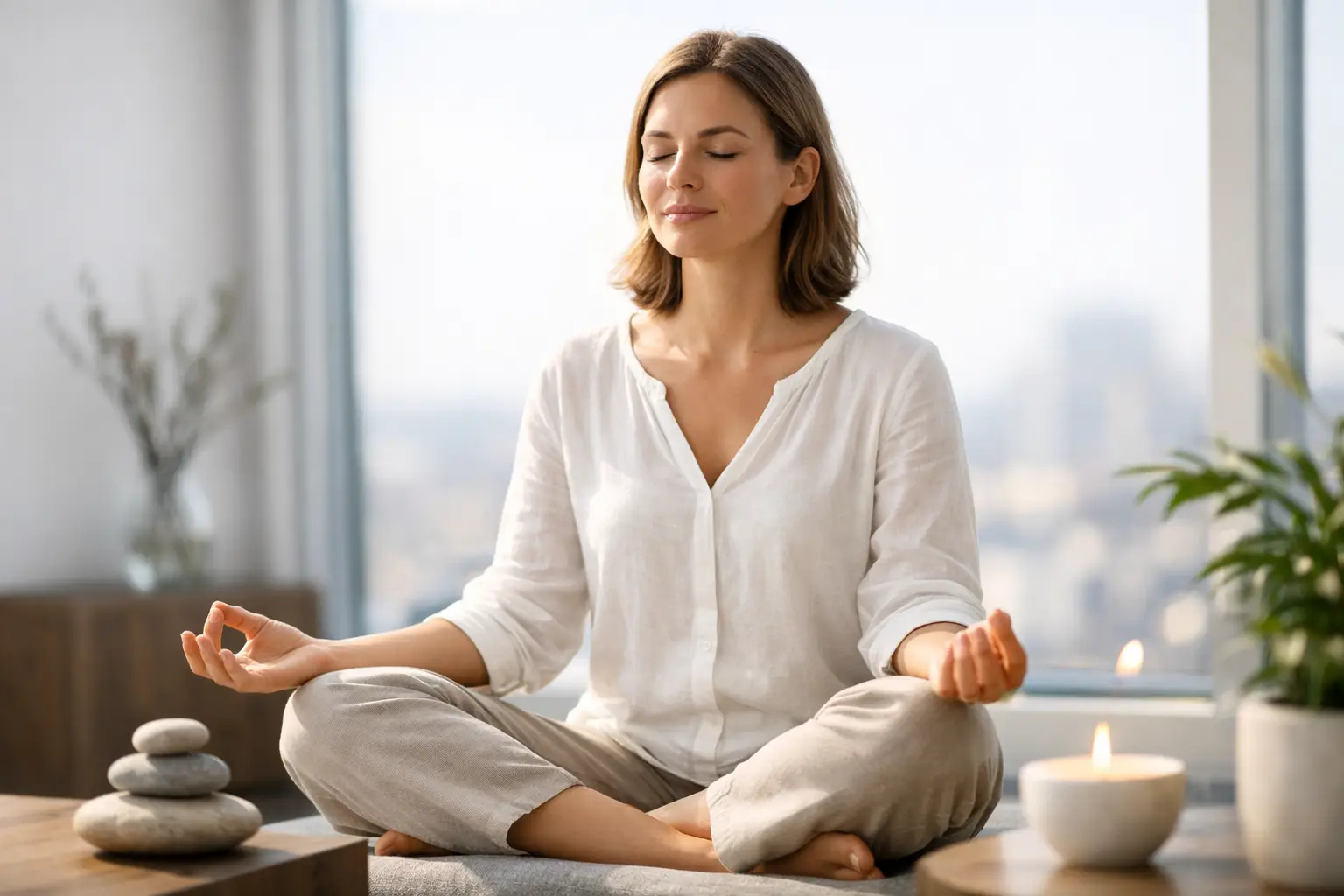
Some forms of confusion do not come from lack of intelligence. They come from inner noise. You may be capable, responsible and spiritually sincere, yet still feel pulled in too many directions to hear your own inner understanding clearly. This is where meditation for inner clarity becomes more than a calming habit. It becomes a way of creating enough stillness to recognise what is true beneath stress, emotion and continual mental activity.
When the mind is crowded, even simple decisions can begin to feel heavy. You may second-guess yourself, become overly influenced by the reactions of others or lose contact with your own centre. Clarity is not something that needs to be forced. It often becomes more accessible when agitation settles and awareness becomes steady enough to observe without immediately reacting.
What meditation for inner clarity really does
Many people begin meditating because they want relief from stress, better sleep or greater emotional balance. These can all be meaningful reasons to begin, but inner clarity asks for something deeper. It is not merely about feeling calm for a few minutes. It is about learning to distinguish thought from emotion, reaction from discernment and mental noise from deeper awareness.
True clarity is usually quieter than people expect. It does not necessarily arrive as an intense insight or an unmistakable inner voice. Often it appears as simplicity: the recognition that something is right, that something needs to change or that a decision does not need to be made immediately.
Meditation can support this process by creating distance from continual mental movement. The breath may become quieter, emotional intensity may become easier to observe and thoughts may gradually lose some of their urgency. The purpose is not to eliminate thought but to stop treating every thought as something that must immediately be followed.
Within spiritual traditions, this deeper level of discernment is sometimes described as inner knowing. It should not be confused with impulse or unquestioned intuition. Mature inner guidance develops together with grounding, experience, humility and the willingness to test what is perceived against reality.
Why clarity is often blocked
People sometimes assume that lack of clarity means they need more information. Occasionally that is true. At other times, the problem is that too much information, stimulation and emotional activity are already competing for attention.
Mental overload is one layer. Emotional pressure is another. Physical tiredness, poor sleep, unresolved concerns and continual sensory stimulation can all make clear thinking more difficult. Some people also describe an energetic sense of depletion or fragmentation, particularly when they have been carrying stress for a long period.
These experiences should not automatically be interpreted as energetic imbalance. Fatigue, brain fog, concentration difficulties and emotional instability can have physical or psychological causes that deserve appropriate attention.
Within a holistic spiritual approach, however, body, emotion, thought, energy and Consciousness are not treated as unrelated compartments. Meditation can help one part of this wider process by creating enough inner space to observe what may actually be contributing to confusion.
For one person, clarity may return once overstimulation is reduced. Another may need to address grief, exhaustion, poor boundaries or a difficult life situation before the mind can settle more deeply. There is no failure in this. Clarity sometimes requires practical change as much as meditation.
Signs your practice is creating real inner clarity
Inner clarity is rarely dramatic. Its deeper signs usually appear in ordinary life.
You may begin making decisions with less fear and less compulsive second-guessing. You may recognise more quickly when something is not yours to carry or when you are allowing another person’s emotions to determine your own state.
Speech may become simpler because you no longer feel the same need to explain or defend yourself continually. You may also become more capable of remaining with uncertainty without immediately trying to remove it.
Meditation can reveal misalignment as well as peace. Greater awareness may show you where you are overgiving, avoiding a necessary truth or continuing a pattern simply because it is familiar.
This can be uncomfortable, but clarity is not the same as comfort. Sometimes becoming clearer means recognising that something in life needs to be changed.
The important question is not whether meditation makes every decision easy. It is whether you are becoming increasingly capable of seeing without being immediately governed by fear, pressure or habit.
A simple meditation for inner clarity
If you are new to meditation, keep the practice simple. Complexity is not the goal. Presence is.
Step 1: Prepare your space and body
Sit upright in a quiet place where the body can remain comfortable without collapsing into sleep. Allow the hands to rest naturally and soften unnecessary tension in the jaw, shoulders and abdomen.
Before trying to become mentally quiet, take a moment simply to arrive. Feel the weight of the body and the physical support beneath you. This grounding is important because clarity becomes more difficult when attention remains scattered between what has just happened and what still needs to be done.
There is no need to create a perfect meditation environment. A few uninterrupted minutes and a willingness to become present are enough to begin.
Step 2: Allow the breath to settle
Become aware of natural breathing through the nose and allow it gradually to become smoother and quieter. Do not force a specific breathing ratio unless you have been taught one.
Follow several breaths with simple attention. If the mind moves away, notice that movement and return.
Breath awareness does not need to be regarded as merely a beginner technique. Its value lies in bringing attention back from scattered thought into immediate experience.
Step 3: Observe without chasing
Once the body and breathing have settled, begin noticing the movement of the mind.
Thoughts will arise. Emotions may also become noticeable. You do not need to suppress them, analyse them or continue the conversation they are trying to begin.
Simply notice what has appeared and return to awareness.
This is where many people mistakenly conclude that meditation is not working. They expect thought to disappear. In reality, an important part of practice is recognising that a thought has arisen without automatically becoming absorbed in it.
Clarity develops through this distinction.
Step 4: Place attention in the Heart
After several minutes, bring awareness gently towards the centre of the chest.
Within IAMGODIAM, the Heart is not treated merely as a place of emotion. It is connected with Love, understanding, compassion and a deeper form of human awareness.
Do not try to manufacture warmth, emotion or a special energetic sensation. Simply become quiet there.
If the Heart feels peaceful, remain with that. If emotion becomes visible, observe it. If nothing particular happens, continue without judgement.
The purpose is not to produce an experience. It is to allow mental activity to become less dominant so that a deeper level of awareness has space to emerge.
Step 5: Hold one clear inner question
When the mind has become quieter, you may bring one simple question into awareness.
It could be: What do I need to understand more clearly?
Or: What is the next truthful step?
Then stop questioning and become quiet again.
Do not expect an immediate answer. Clarity may not arrive as words. Sometimes the meditation simply reveals that you are not ready to decide yet. At other times, understanding becomes clearer hours or days later.
An inner answer should also be approached with discernment. Meditation can help you listen more deeply, but it does not make every impression infallible.
Step 6: Close with stillness
Remain quietly for another moment without seeking anything.
Before opening your eyes, become aware again of the physical body and the room around you. Allow the transition back into activity to happen gradually.
If something genuinely important became clear, you may write it down afterwards. This can help distinguish a meaningful recognition from the many thoughts that pass through the mind during practice.
How often should you practise?
There is no universal duration that every person must follow. A shorter practice carried regularly is often more useful than forcing a long meditation that becomes impossible to sustain.
Ten or fifteen minutes may be enough for a beginner to establish rhythm. Someone with more experience may naturally sit longer. What matters is consistency and whether the practice leaves you increasingly grounded rather than depleted or overwhelmed.
If confusion is strongly connected with stress and overstimulation, regular quiet meditation may be helpful. If it is connected with significant trauma, severe exhaustion, depression, anxiety or another health concern, meditation may need support from appropriate professional care or other forms of healing.
Within a whole-person approach, Ayurveda, chakra work and energy healing may also have a place. These approaches should not simply be accumulated as techniques. Their value lies in understanding how they relate to the same human being.
The mind does not function in isolation. Sleep, food, physical health, emotion, daily rhythm and spiritual life can all influence the quality of attention.
Common mistakes that block clarity
One common mistake is using meditation to avoid truth instead of meeting it. If practice becomes a way of escaping a difficult conversation, necessary decision or practical responsibility, meditation may create temporary quietness without resolving the real source of confusion.
Another mistake is expecting an answer every time you sit. Meditation is not a mechanism for producing certainty on demand. Some sessions may feel clear, while others simply reveal how tired, distracted or emotionally affected you are.
Inconsistency can also make it difficult for a practice to mature. This does not mean missing a day is a failure. It means that repeatedly abandoning one practice in favour of the next new technique makes it difficult to discover what sustained inner work can actually develop.
Lifestyle matters as well. Continual digital stimulation, poor sleep, emotional overload and constant outward activity can recreate the very noise that meditation is trying to quiet.
Meditation can support clarity, but the rest of life must gradually support it too.
When guidance makes a difference
There are times when self-practice is valuable but no longer sufficient. If you repeatedly circle the same confusion or become uncertain about the difference between emotion, intuition, fear and spiritual insight, experienced guidance can help bring greater perspective.
A mature teacher should not simply tell you what every inner experience means. Good guidance helps you develop your own discernment.
Sometimes what is needed is greater grounding. Sometimes the problem is exhaustion rather than spiritual blockage. At another stage, greater discipline or a deeper meditation practice may be appropriate.
The teacher’s responsibility is partly to recognise these differences and not to give deeper practices before the person is ready to carry them.
Within IAMGODIAM, meditation is therefore not treated as an isolated wellness technique. It belongs to a wider path involving grounding, energetic awareness, Ayurveda, spiritual discipline, the Heart and the gradual development of Consciousness.
Clarity is not about having an answer to everything. It is the increasing ability to see without being immediately pulled away by fear, emotion or mental noise.
What is true within you does not need to be invented. But learning to recognise it requires quietness, discipline and discernment.
Meditation creates the space in which that deeper listening can begin.