
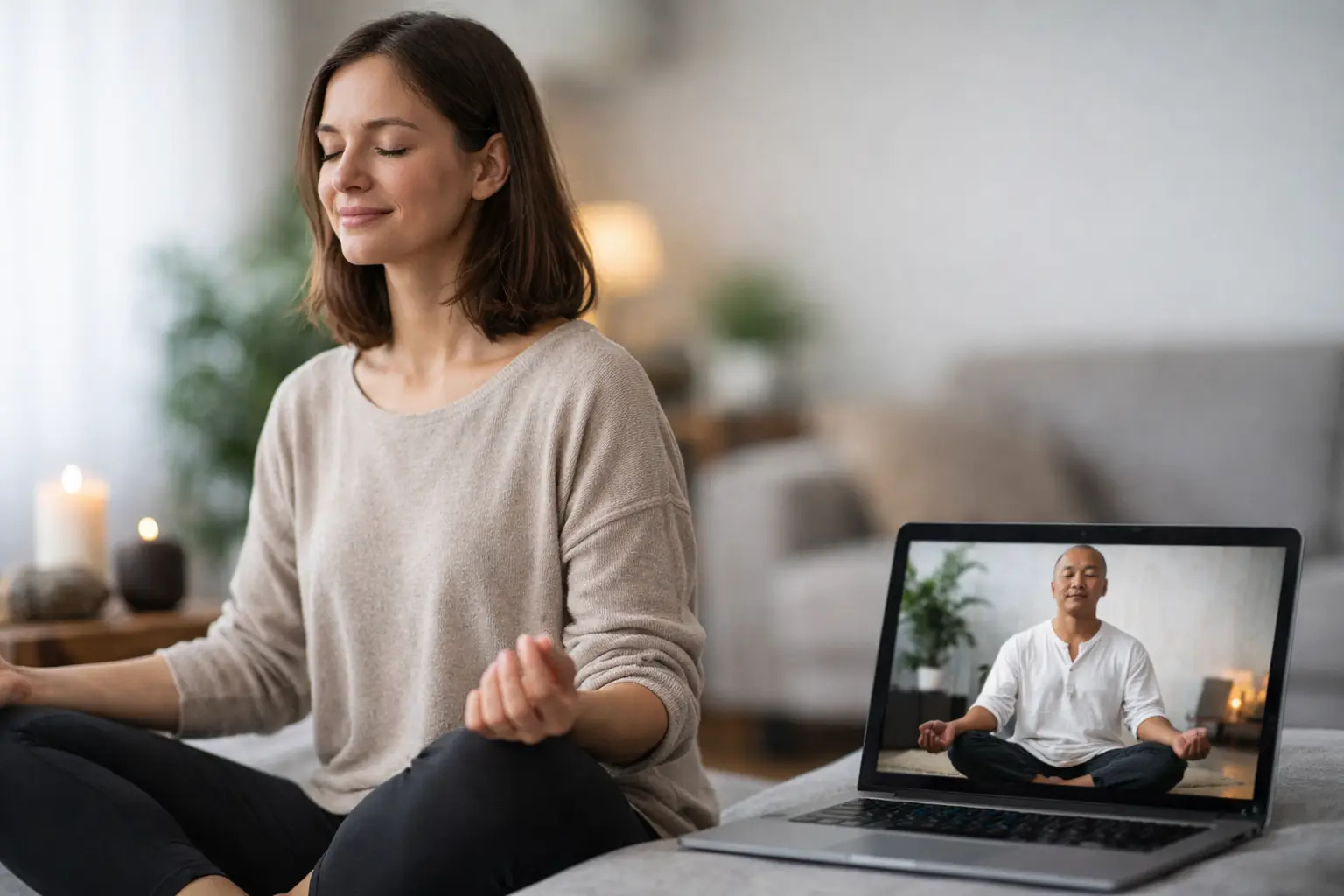
A scattered mind rarely becomes steady through occasional effort alone. Real change develops through rhythm. Weekly online meditation classes can offer that rhythm by giving people a regular point of return, a time in which outward activity is set aside and attention is consciously brought inward.
For many people, the difficulty is not lack of interest in meditation but inconsistency. They may use an app for several days, meditate when life becomes difficult or return to a recording whenever they happen to have time. Then work becomes demanding, sleep changes, emotions accumulate and the practice gradually disappears.
This is why a regular weekly rhythm can be valuable. It creates structure around something that otherwise depends entirely upon mood and available time. Over time, meditation can begin to occupy a genuine place in life rather than remaining something used only when stress has already become overwhelming.
What weekly online meditation classes actually offer
The value of weekly online meditation classes is not convenience alone. Their deeper value lies in continuity and guidance.
When meditation takes place within a regular structure, each session does not have to feel like starting again from the beginning. The practitioner gradually becomes familiar with turning inward, observing thought, allowing the body to settle and returning attention towards a deeper centre.
For beginners, this structure can remove some of the uncertainty around practice. A restless mind does not automatically mean that meditation is being done incorrectly, and a session that feels ordinary is not necessarily less valuable than one that feels deeply peaceful.
For more experienced practitioners, regular guidance may offer another kind of value. It can provide discipline, refinement and an opportunity to examine whether practice is genuinely deepening or has simply become familiar.
The purpose of guidance should not be to make someone dependent upon a weekly class. It should gradually help the practitioner become more capable of carrying meditation into the rest of life.
Why weekly practice can create deeper change
Meditation is learned through repetition. One meaningful session may provide a period of quietness, but a rhythm of practice allows greater awareness to develop gradually.
Stress, emotional patterns and habitual reactions are rarely created in a single day. It is therefore unrealistic to expect one meditation to transform patterns that have been reinforced for months or years.
Regular practice creates repeated opportunities to notice those patterns. You may begin to recognise a reaction earlier, see how quickly thought moves towards worry or become more conscious of the situations in which attention continually becomes scattered.
This is where deeper development begins. The purpose is not simply to become calm during meditation, but to become increasingly aware of what happens when meditation is over.
Within spiritual traditions, there is also an energetic dimension to practice. Meditation is not viewed solely as thought management but as part of working with the wider human being. Body, energy, emotion, mind and Consciousness influence one another, and regular spiritual practice can provide a stable framework in which these relationships are explored.
This does not mean weekly meditation guarantees better sleep, emotional healing or energetic restoration. Such experiences have many influences. The value lies in establishing a disciplined rhythm through which greater awareness can gradually become part of ordinary life.
Weekly online meditation classes vs apps and self-guided practice
Meditation apps can be useful. They provide easy access to short practices, reminders and introductory guidance, and for some people they are an excellent way to begin.
Their limitation is usually not that they are digital, but that they can encourage continual choice. A person may listen to one meditation today, another tomorrow and an entirely different technique next week. It becomes easy to consume meditation without ever remaining with one practice long enough for it to mature.
Weekly online meditation classes can provide a different experience because the emphasis is placed upon continuity rather than variety. The practitioner returns to a recognisable structure and gradually learns how to remain with the practice even when enthusiasm changes.
Self-guided meditation can also become very deep. In fact, a mature spiritual path should ultimately strengthen the person’s capacity for independent practice.
The question is therefore not whether an app, a class or self-practice is universally superior. It is what the person needs at the present stage.
Someone who needs a simple introduction may find an app sufficient. Someone who repeatedly loses rhythm may benefit from regular guidance. Someone with an established practice may need less external support and greater personal discipline.
The form should serve development, not become the goal itself.
What to look for in a truly effective class
Not all weekly online meditation classes offer the same depth. Some are intentionally designed for relaxation or general wellbeing, while others belong to a broader spiritual path.
Neither approach is automatically wrong. What matters is knowing what you are looking for.
A good class should have a coherent method. The teacher should be able to explain why particular practices are being used and how they belong together rather than continually introducing new techniques simply to maintain interest.
The teaching should also respect different levels of experience. Beginners need foundation and simplicity. Deeper practices require readiness, discipline and sufficient understanding to carry what is being given.
The teacher matters as well. Spiritual guidance requires more than the ability to lead people through a pleasant meditation. Experience, integrity and discernment are important, particularly when people begin interpreting emotional or energetic experiences through spiritual language.
Traditions such as Ayurveda, chakra work and energetic healing can deepen a wider understanding of the human being when they are used coherently. They should not simply be added to meditation as a collection of attractive spiritual techniques.
The deeper question is whether the teaching helps the person become more grounded, conscious and responsible in ordinary life.
The role of guidance in spiritual growth
There is great value in personal practice, but there can also be value in learning from someone who has travelled further along a particular path.
Spiritual development is not always linear. Meditation may sometimes feel quiet and clear, while at other times the practitioner encounters resistance, restlessness, emotion or uncertainty. These experiences do not automatically indicate either progress or failure.
A mature teacher does not dramatise them. They help the practitioner develop discernment and understand when to continue, when to simplify and when another form of support may be needed.
Guidance should also be progressive. Not every student needs advanced teaching immediately, and deeper spiritual material should not be given simply because someone is curious about it. Foundation comes first.
Within IAMGODIAM, this principle is important. Meditation is not treated as an isolated technique for temporary stress relief, but neither is every person immediately brought into the deepest level of spiritual practice. Development unfolds according to readiness, responsibility and the capacity to carry what is being taught.
Many people begin because they want greater calm. As awareness develops, another question may arise: What am I actually becoming through this practice?
That is where meditation begins to move from relaxation towards spiritual development.
How to begin if you feel overwhelmed
When life already feels full, adding another commitment can seem counter-intuitive. But this is precisely why a regular spiritual rhythm can sometimes help. Without a defined place for meditation, inner practice is often the first thing removed when external responsibilities increase.
Begin realistically. A weekly class or another regular guided practice can provide an initial structure, but it should not be expected to carry the entire spiritual life for you.
Allow each session to be what it is. Some may feel peaceful. Others may reveal how tired, distracted or emotionally affected you actually are. Meditation does not need to produce the same experience every time in order to have value.
Then observe what happens between sessions.
Are you becoming more conscious of your reactions? Do you recognise overstimulation sooner? Are you remembering to become quiet before stress has reached its highest point? Are you beginning to carry awareness into conversations, decisions and ordinary responsibilities?
These questions matter more than whether a particular meditation felt powerful.
If regular practice eventually leads you towards deeper energetic work, Ayurveda, chakra healing or a more structured spiritual path, that progression should happen consciously rather than through pressure. Deeper work needs to build upon a stable foundation.
IAMGODIAM follows this wider principle. The purpose is not to keep people permanently dependent upon weekly meditation classes, but to help them move from occasional practice towards a more conscious relationship with meditation, energy, the Heart and the deeper Self.
The most valuable spiritual practices are often not the most dramatic ones. They are the practices that remain alive after novelty has disappeared and that gradually become part of the way you live.
A weekly rhythm can help establish that beginning. The deeper work is learning to carry the stillness beyond the session until meditation is no longer simply a place you visit, but something that increasingly changes the Consciousness with which you meet life.